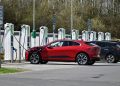





















If it feels like parking the car when you pop the shops is a lot harder than it used to be, you’d be right – and the UK’s “carspreading” problem is largely to blame.
Our addiction to ever-larger cars has grown so strong that more than 4.6 million “supersized” SUVs are now too big for the minimum sized urban on-street parking space of 4.8 metres long and 1.8 metres wide.
Since 2018, according to data from Thatcham Research (an organisation that evaluates new cars on behalf of the insurance industry), the average width of new models of car has increased by nearly 6cm. Compared to the average width growth between 2001 and 2020 – 10cm – it’s clear cars are getting bigger, quicker and quicker. The average weight of new cars has ballooned by 227kg since 2018, too. And, the average car bonnet height rose from 77cm in 2010 to 84cm in 2024, according to clean energy think-tank Transport and Environment.
Part of this is down to more safety features being squeezed in (such as extra airbags), but it is also simply a desire for more comfort and a more commanding view: thicker seating, better sound insulation, and more elbow room.
But this bloat isn’t just making it harder to squeeze out of your car without dinging the one in the next bay. Bigger, heavier cars are ruining our roads and endangering our health. SUVs emit roughly 20 per cent more emissions than an average medium-sized car, according to the International Energy Agency, which blames them for nullifying the improvements in energy consumption and emissions achieved in recent decades. And, if nothing is done about it, carspreading is only going to get worse, as the rate at which Britons are buying these huge vehicles is accelerating.
Including slightly smaller models, SUVs as a group accounted for 33 per cent of all new car sales in 2024. Initial figures from Britain’s auto trade body the Society of Motor Manufacturers and Traders (SMMT) suggest this year that’s up to 38 per cent. This made them Britain’s favourite type of car for the first time, as models such as the Ford Puma, Kia Sportage and Nissan Qashqai flew out of the showrooms. Twenty years ago 3 per cent of cars on the road were SUVs; now it’s 30 per cent.
Yet SUVs are making life more hazardous, and not just in car parks. Apart from squeezing space on roads designed for smaller cars and ramping up the stress of city centre shopping trips, the billowing size and weight of the country’s vehicles (up to almost three tonnes for the biggest SUVs) poses a significant safety risk. The occupants of an SUV may be more safe in a collision, but a recent scientific study found that an adult pedestrian or cyclist was 44 per cent more likely to be killed when hit by an SUV than a standard car – rising to 82 per cent for children.
These giant vehicles are also bad for air quality and the climate. Because of their much greater weight, SUVs cause considerably more wear and tear on the roads, resulting in more and bigger potholes, leading some to call for road tax to be assessed on vehicle weight. And their brake pads and tyres throw off more miniscule rubber fragments. These incredibly fine particles – many times thinner than a human hair – can go deep into the lungs and bloodstream and have been linked to everything from cancer and stroke to diabetes and dementia.
SUV versions of regular sized petrol cars also emit more planet-warming CO2. Volkswagen’s current 1.5-litre T-Roc SUV, for example, produces 11 per cent more CO2 than the 1.5-litre VW Golf on which it is based. And bigger cars, whether powered by electricity or fossil fuels, use more raw materials in production, further pushing up carbon emissions.
More and more people think enough is enough, and are calling for strong steps to be taken to reduce SUV numbers. A nationally representative poll of 2,133 UK adults by YouGov, commissioned by Clean Cities, found that 61 per cent of UK passenger car owners agree that “SUVs take up too much space”, while only 19 per cent disagree. Meanwhile, 71 per cent of car owners agree that SUVs make parking more difficult, while only 15 per cent disagree.
One answer which is gaining support is to hit SUV drivers in the pocket. In a recent editorial for the British Medical Journal, public health experts pointed out that the UK currently has some of the lowest tax charges on large cars in Europe, and argued that reforms to vehicle excise duty could create stronger incentives for people to switch to smaller cars.
“A BMW X5 has an acquisition tax of £3,200 in the UK versus £66,000 in France, and it is therefore unsurprising that sales of the largest SUVs are four times higher in the UK than in France,” they said.
SUVs are typically taxed more than lighter cars because vehicle excise duty includes charges for CO2 emissions, which tend to be higher for heavier cars. But they do not face additional taxes for their greater weight and the problems that causes – something the government has no plans to change at the moment.
At a local level, though, the tide is turning. Cardiff council announced in October that it would become the first city in the UK to charge larger SUVs weighing over 2.4 tonnes more for parking than regular cars, although the extra amount and start date have yet to be finalised. This follows the success of a similar scheme in Paris. The city voted last year to treble charges from €18 (£15) an hour in the city centre and €12 (£10) an hour elsewhere.
Now London is going to war with SUVs, too. Westminster council has introduced a parking scheme in which charges are based on a car’s CO2 emissions, which has increased charges on some (but not all) SUVs. Electric and plug-in hybrid SUVs are exempt from these charges. In Islington, there are proposals for all cars weighing more than two tonnes to pay an extra £200 or more a year for a residential parking permit. Lambeth Council is considering a new scheme that would base parking fees on vehicle size rather than emissions.
And in June 2025, London Assembly Members urged Mayor Sadiq Khan to increase taxes and parking fees for SUV drivers across the city. The momentum towards higher charges for SUVs, in whatever form they may take, looks strong.
Your next read

Given how keen the Government is to raise taxes from anywhere it can at the moment, an extra levy on SUVs could be a valuable source of income. One analysis from Transport and Environment argues that introducing a large vehicle levy in line with the one in France would raise nearly £2bn a year. Whether the Government has the stomach for that particular tax, however, is far from certain.
However, while French-level taxes on SUVs may be a bit extreme, the Government should bite the bullet on this to ensure these enormous vehicles pay for the extra hassle they cause – adding a few thousand pounds or so to acquisition taxes on supersized SUVs and leaning on local authorities to charge more for parking.