




















Reflection of Life is an illustrated debut that explores grief, faith, identity, and renewal through a poetry practice that consciously moves beyond the printed page and spoken performance. While the collection engages with recognisable emotional terrain, its distinctiveness lies in its formal ambition and its inclusive vision of what poetry can be and who it can serve.
Grover’s background informs the work at the level of craft rather than autobiography. After experiencing vocal-cord health challenges, she later moved to a new country and returned to university at the age of 50 to complete a Master’s degree in Creative Writing. The imprint of that journey is evident throughout the collection: silence, pause, repetition, and visual pacing are treated not as absences, but as compositional tools. Her poetry, previously published in anthologies and zine collections, retains a small-press immediacy—direct, intimate, and reader-facing—while building toward a coherent artistic method.
The collection is organised into six sections—Loss and Longing, Resilience and Renewal, Faith and Reflection, Everyday Life and Identity, The Transformation, and Expression. Rather than a linear narrative, these sections trace a cyclical emotional movement, reflecting how grief, faith, and selfhood are revisited rather than resolved. Across the book, Grover frequently grounds feeling in domestic and food-based imagery. Cooking, nourishment, and inherited household rituals function as emotional architecture, anchoring memory in the body and the everyday.
Stylistically, Grover works primarily in free verse, favouring declarative lines, flexible stanza lengths, and direct address. Poems often move by accumulation rather than argument. Repetition is used intentionally as a devotional and meditative device, echoing the rhythms of prayer and inner reflection; meaning deepens through return and resonance rather than narrative momentum.
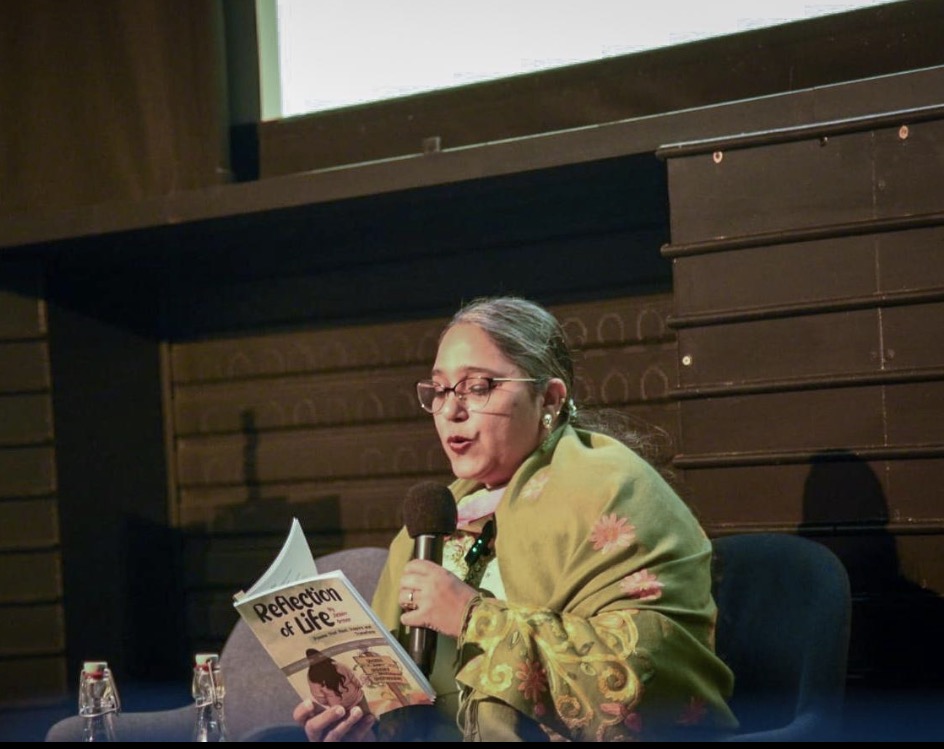
Two poems, in particular, illuminate the collection’s ethical and formal ambitions: Mistaken Identity and Naanka Vehra. Both have been further developed into visual poems, extending their reach beyond the page. Mistaken Identity confronts misrecognition and social visibility, drawing on lived experience, including Grover’s observations of her son’s encounters with mistaken perception. Its clarity and insistence on naming align it with contemporary lyric practices such as the Stop and Frisk sections of Claudia Rankine’s Citizen: An American Lyric, where visual structure and interruption function as ethical form. Naanka Vehra, rooted in memory and place, is rich in tactile domestic detail and has been particularly well received in its visual form, including recent appreciation at Keighley Creative, Airedale Centre, Bradford.
What ultimately gives Reflection of Life its coherence is the vision underpinning its form. Grover’s expansion of poetry beyond voice emerges from lived vocal-health challenges and a long-held awareness of how literary spaces often privilege fluency and performance. Writing and doodling began as grounding practices—methods supported by research into creative regulation—and later became integral to the work’s aesthetic. From this emerges a quietly radical proposition: that poetry need not depend on voice alone. Through visual poetry, Grover positions poetry as an inclusive, sensory, and relational experience—one that can be seen, felt, and shared. In doing so, Reflection of Life offers not only a debut collection, but a thoughtful model for poetry as collective wellbeing and wider access.