

















The luxury goods section on the first floor of a department store is always bustling. People stand in long lines to see the latest bags for themselves, holding a smartphone in one hand and a credit card in the other. Turn a corner, and advertisements for diet plans, fitness apps, and skincare follow relentlessly. It is an era that commands us to eat less, look prettier, and consume wisely.
However, there is a strange paradox. A society that fuels desire more than any other becomes peculiarly stingy when faced with the desires of women. Loving a bag is labeled as vanity; wanting to be beautiful is dismissed as being immature. While told to “face reality,” a woman who is “too realistic” is also criticized.
I wanted to translate this contradiction into a single painting. Created through a collaboration with the Korea Racing Authority (KRA), <Feigning Innocence: Speaking of Women> starts from this very question. The title itself is full of playfulness. It layers the animal “horse” (mal) onto the rhythm of the colloquial Korean phrase that starts with “Speaking of women…”. Horses and women—they seem like entirely different beings, but aren‘t they actually strangely alike? At least in the moment they become honest about what they like.
In the painting, I am mounted on a large white horse. I wear a red jeogori (top) layered over a subtly transparent ink-black chima (skirt). The horse’s body stretches across the center of the canvas, occupying nearly the entire frame. However, looking slightly downward, two temptations lie on the ground. One is a tempting carrot placed neatly in front of the horse; the other is a red luxury bag and flower-embroidered high heels dropped near the horse’s hoof.
The horse does not hesitate. It bows its head deeply and moves straight toward the carrot, following its instinct exactly as it is. Conversely, I, sitting on the horse, lean forward and stare intently below. My eyes are fixed not on the carrot, but on the red bag and shoes. The slightly bowed head, the cautiously extended fingertip, yet a distance not yet reached—within this awkward gap lies “woman’s desire.”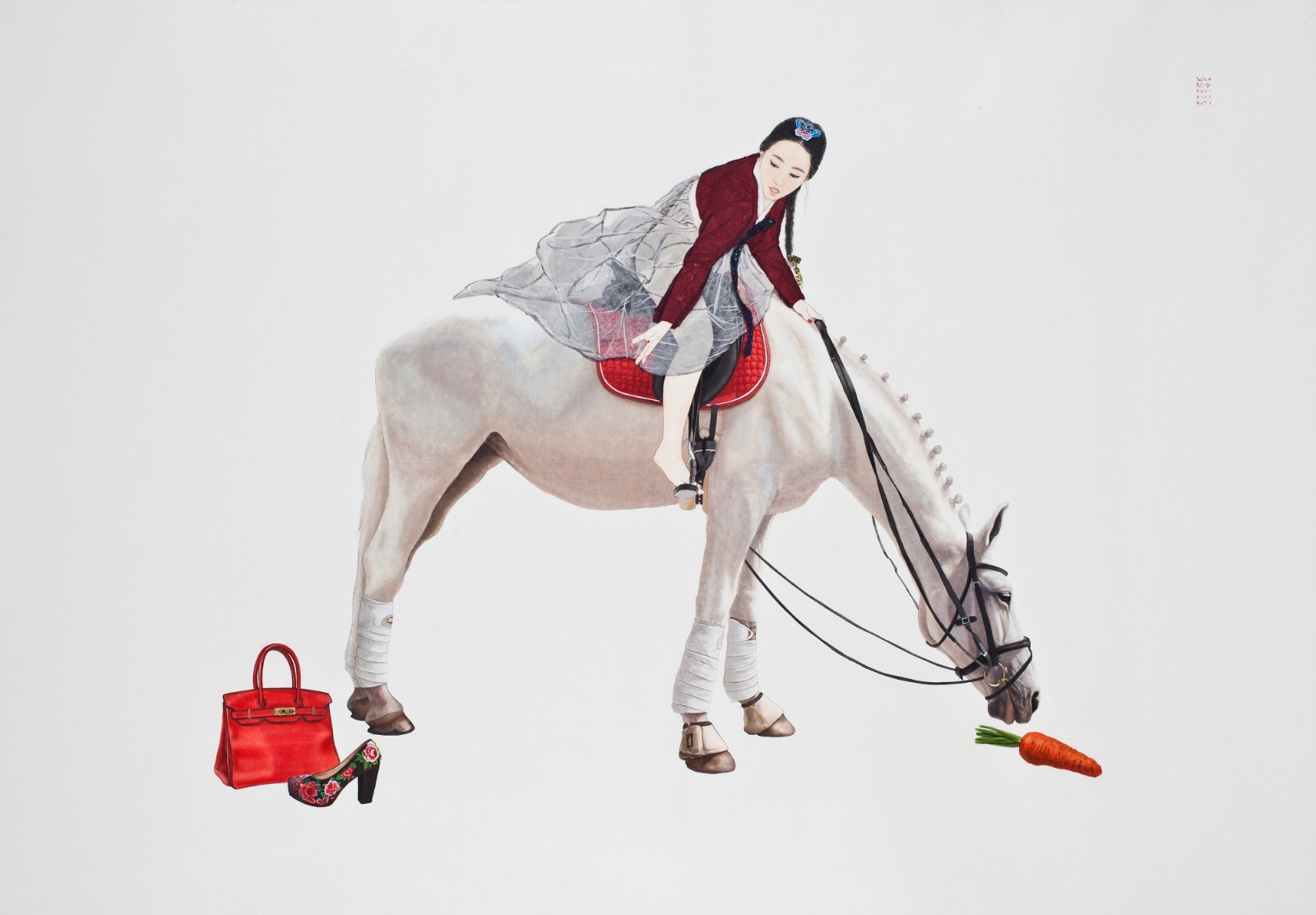
No one criticizes a horse for liking carrots. People say, “It’s cute,” or “The way it eats is lovely.” However, the moment a woman says she likes bags and shoes, the tone of the conversation shifts. Questions like “What is left after that?” or “Isn’t that vanity?” follow. It is not the scale of the desire that is the problem, but the evaluation that changes depending on who the subject expressing the desire is.
<Feigning Innocence: Speaking of Women> subtly twists this point. Is the carrot the minimum energy for the horse to maintain life, or a reward earned after training? Are a woman’s bag and shoes mere luxuries, or are they armor for grooming oneself to face the world? For too long, we have been generous toward the desires of others while applying strict standards of morality and reason to the desires of women.
While preparing this piece, I interviewed actual jockeys. I learned that horses particularly love sweets like sugar cubes and carrots, and like humans, they train on treadmills and swim in pools. Hearing those stories, horses suddenly did not feel distant. “Ah, horses are also managed like us, and they have a weakness for sweet things.” Once that realization hit, the brush finally began to move.
Thus, this painting is akin to a “parallel theory of desire.” Though horses and women are different beings, the spark in their eyes when looking at something they love is identical. Whether it is appetite, materialism, or the need for recognition, humans and animals are perhaps at their most honest in front of it. I wanted to view that honesty with a smile rather than criticism.
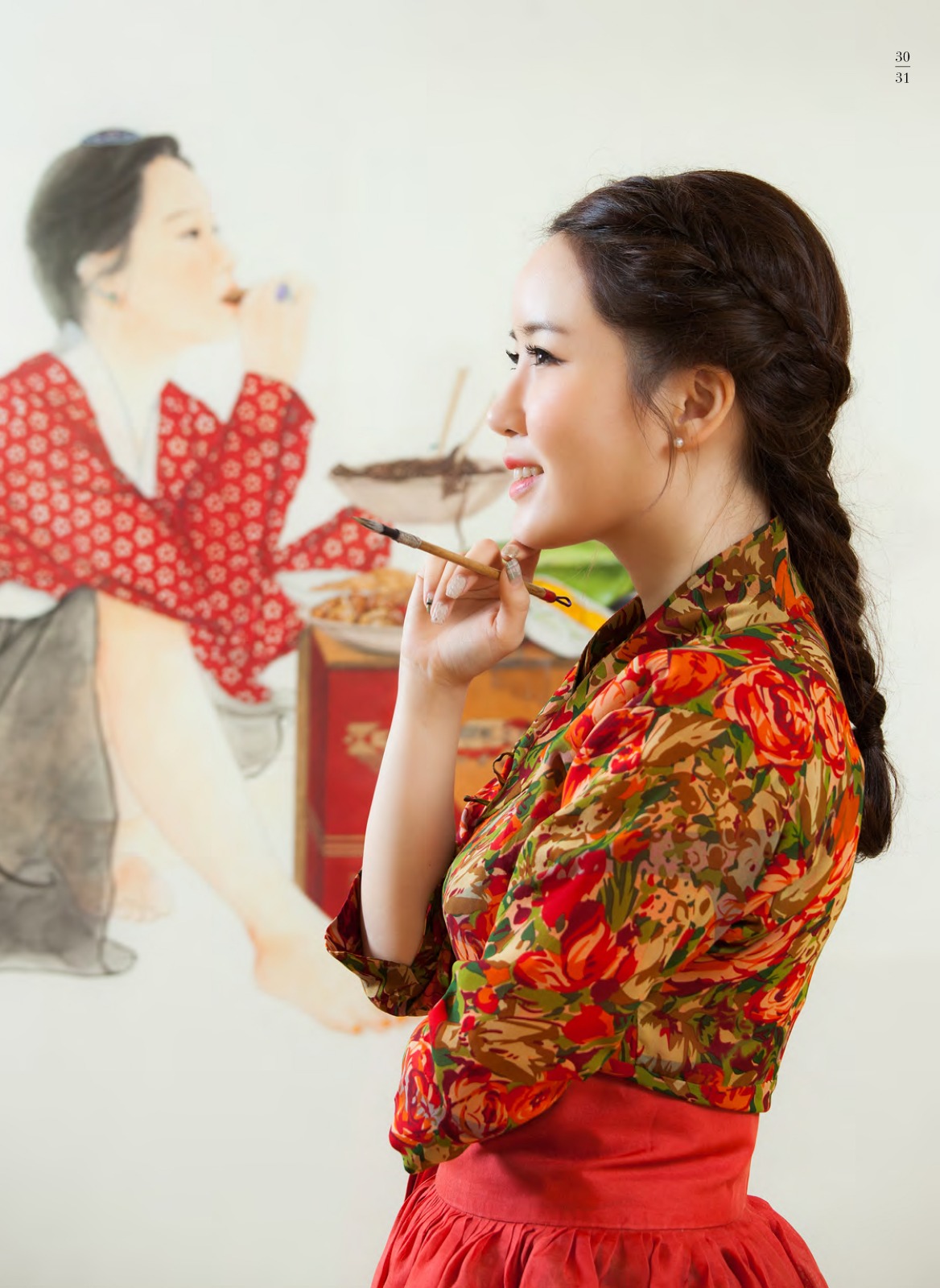
This honesty becomes clearer as it clashes with the image of hanbok. For many, hanbok remains a symbol of elegance, nobility, and secrecy—a garment that demurely covers the body and mandates cautious behavior. Yet, in the “Feigning Innocence” series, I wear that hanbok while striding up stairs, taking large bites of massive cakes, or, as in this case, riding a white horse and coveting bags and shoes.
In these exaggerated daily scenes, the hanbok is no longer a demure shell. I first paint the figure as a nude, then dye and attach thin hanji (Korean paper) to dress her in hanbok. The translucent skin and wrinkles visually implement the phrase “seeing right through someone.” It is the moment where the desires and emotions breathing beneath the surface subtly peek through the refined image of femininity expected by society.
In <Feigning Innocence: Speaking of Women>, the color red symbolizes the temperature of that desire. The red of the jeogori, the saddle on the horse’s back, and the bag and shoes on the floor are all connected by a single hue. These prominent reds quietly link the horse’s instinct, the woman’s taste, and the gaze of the viewer looking from outside the frame. When we long for something intensely, wouldn’t the color flashing in our eyes also be this hot?
I wanted to say through this painting: it is not the calculating woman who is cold-hearted, but the gaze that prevents women from expressing their desires. Just as we allow a horse its carrot, can we not be more generous in allowing women their bags, shoes, or whatever else they desire? A society where one can say “I like this” without hiding it—that is a truly healthy community.
Where is your gaze pointed today? Are you bowing your head toward a sweet carrot like a horse, or are you secretly thinking of a red bag and shoes tucked away in your heart?
I lean down slightly from the horse, and you pause for a moment before the screen. We are in different places, but the look in our eyes as we gaze at what we love is the same. Call it instinct or call it taste.
I wanted to quietly suggest through this single painting that being honest is the true charm—of women, and of horses.
Artwork Details: Kim Hyunjung, <Feigning Innocence: Speaking of Women>, 130cm x 188cm, Ink and light color on Hanji, collage, 2015. (Courtesy of Kim Hyunjung Art Center)
About Artist Kim Hyunjung Korean painter Kim Hyunjung graduated from Sunhwa Arts Middle and High School and Seoul National University’s Department of Oriental Painting, subsequently completing her doctoral coursework at the same university. She was active as “Daenggi Unni” on EBS and serves as a public relations ambassador for Seoul City and Hope Bridge. Known as the “Idol of Korean Painting,” she communicates with over 300,000 followers and has popularized “Korean Painting Pop” through her 21st-century genre painting <Feigning Innocence Series>, actively exhibiting both domestically and internationally.