













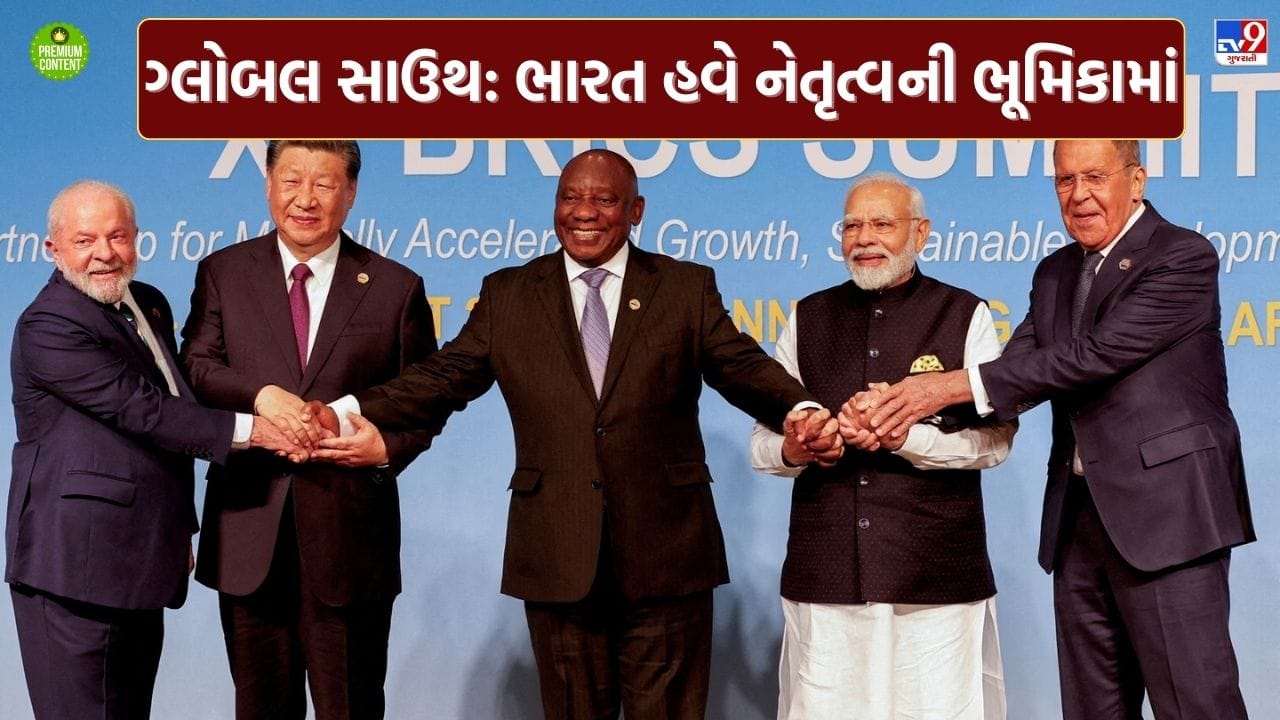
In the last few years the term 'Global South' has taken center stage in global politics. The term has not only been a topic of discussion at the United Nations, G20, BRICS and other international forums, but has become a sign of the shifting global balance of power. India is emerging as the voice of this group of developing countries, especially as Indian Prime Minister Narendra Modi continues to raise the issue of the Global South. Be it the G20 Summit, the United Nations or initiatives like the 'Voice of Global South Summit', India is moving forward with the Global South at its center.
What is the Global South?
The term 'Global South' is usually used for economically less developed countries or developing nations. These countries are mainly located in Asia, Africa and Latin America. The term was first used during the Cold War. Global South countries mainly face economic and social challenges, such as continuously increasing poverty levels, population growth, low income, scarcity of residential land, limited resources for education, inadequate health system are among these challenges.
The Global South refers to countries that have lower incomes or are socially, economically and industrially weaker than countries in the North. These countries face many serious problems. The Global South includes South America, Mexico, most of the Caribbean, Africa, the Middle East, and Southeast Asia.
Marginalized countries of the Global South in the 19th and 20th centuries
The Global South refers to those countries of the world, primarily located in Asia, Africa, Latin America, and the Middle East, and which have historically been marginalized by European colonial rule, economic exploitation, and political marginalization. The term 'Global South' does not refer to a geographic direction, but to the global inequality and development gap. In contrast, America, Europe, Japan and other developed countries are known as Global North.
By exploiting the Global South, the Global North became richer
Historically, during the 19th and 20th centuries, most of the countries of the Global South were occupied by European powers. Natural resources were heavily exploited during this period, fragmenting local economies. Industrialization took place in the West by transporting raw materials from India, Africa and Latin America. This process made the Global North richer, while the Global South became trapped in a cycle of poverty and degradation.
After World War II, many countries gained political independence, but the global power structure did not undergo major changes. Although the Global South dominated the number of member states in the United Nations, real power still remained limited to a few countries. The non-representation of countries like Africa and Latin America among the permanent members of the Security Council is a clear example of this disparity.
During the Cold War period, world politics remained mired in competition between the United States and the Soviet Union. During this time, problems like development, poverty and health of the countries of the Global South could not be included in the global priorities. As a result, the Global South remained marginalized in the global decision-making process for a long time.
The twenty-first century is witnessing a significant change in this situation. India, China, Brazil, Indonesia and other developing countries are becoming the main growth engines of global economic growth today. The world's largest population and youngest workforce is concentrated in the Global South. Hence the role of these countries in the global market and production system has become indispensable.
India's focus on Global South more
The importance of the Global South is also increasing in global challenges such as climate change and the energy crisis. Historically, most carbon emissions have been produced by the Global North, but the most severe impacts are borne by countries in the Global South. This situation has motivated the Global South to raise a more organized voice for global justice and equality.
India's role has become special in the changing global perspective. Since India itself was a victim of colonial rule, it has a historical and emotional connection with the countries of the Global South. During the Cold War, India was a leading member of the Non-Aligned Movement, an attempt to give an independent voice to developing countries.
India emerged as a leader of the Global South
In recent years, Prime Minister Narendra Modi has promoted the idea of 'Voice of Global South' on the global stage. India has tried to gather the concerns and priorities of developing countries by hosting several Global South Summits. During its presidency of the G20, India strengthened its representation of the Global South by taking the initiative to make the African Union a permanent member.
India's development model is also considered an inspiration for the Global South. All these factors including rapid economic growth with democratic system, digital public infrastructure, social welfare schemes and self-reliance in technology have made India a reliable partner for developing countries. India emphasizes cooperation and capacity building, which builds trust among countries in the Global South.
According to analysts, the Global South is no longer just a backward segment of the global order. It is playing an important role in shaping the global future. India has emerged as the voice and leadership of the Global South in these times of change. This role not only enhances India's global prestige, but can also prove to be an important step towards a more equal and balanced global order.
China is not a member of the Global South
The term Global South is also important geographically, as it includes many countries such as North Africa as well as China and India. China was part of the Global South until the end of the Cold War. However, since China has made dramatic progress in lifting its large population out of poverty, it has not been a member of the Global South since then. Yet, China continues to try to establish itself as a leader of the Global South. Emphasizing BRICS expansion is also considered part of China's strategy. However, it is failing against India.
India's chilling answer to crippled Bangladesh, to build an underground railway line by tearing up the earth up to the chicken's neck
. Source