














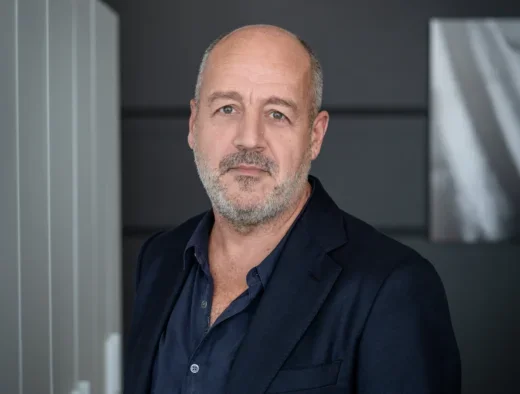
Publishers should be signing AI licensing deals to ensure “strong competition” in journalism, according to Le Monde chief executive Louis Dreyfus.
The French daily newspaper and website has seen a “significant amount of new revenue” including via conversions to paid subscriptions after signing three AI partnership agreements.
Le Monde shares 25% of revenue from its licensing deals with OpenAI, Perplexity and Meta with its staff journalists.
Publishers are currently split between suing AI firms and signing deals, as tracked by Press Gazette since 2023.
Le Monde signed a multi-year agreement with OpenAI in March 2024, the first for a French media organisation.
The deal brings in “significant” revenue for Le Monde in exchange for its content being used both for training and in response to prompts in ChatGPT.
This was followed by a partnership agreement with Perplexity in May 2025, which allows the use of Le Monde’s content to generate answers in response to questions but does not include training.
Then in December Le Monde was among around seven publishers that signed AI content licensing deals with Facebook and Instagram owner Meta, allowing for the real-time use of their content on its Meta AI assistant with links.
Dreyfus told Press Gazette that when Le Monde’s stories appear on ChatGPT, they convert to paid subscriptions 20 times more often than the same stories on Facebook, and 50 times more than on Google Discover.
“So far, it has brought us a significant amount of new revenue for several years,” he said.
“We have decided to share with the newsroom part of this revenue, meaning that every staff journalist at Le Monde will get a yearly bonus based on these partnerships.
“We are much better referenced on those players, and we are getting new subscribers, so I don’t see any drawbacks so far.”
Dreyfus said he is happy to see many “major Western publishers have signed deals”, from CNN and Fox News to The Washington Post and USA Today, but that a lack of completed deals in France makes him “worried for the economy of our industry”.
“My interest is to have strong competitors able to hire more journalists, and to have strong competition.
“If at some point I’m the only one to be able to hire journalists [and] still growing, I will have a market issue.”
Le Monde has 680,000 subscribers, 580,000 of which are digital. Total paid circulation grew by 3% year on year to January 2026, according to Dreyfus.
He said average monthly revenue per digital subscriber has increased from just above €10 (£8.72) to €12 (£10.47) a month in the past two years.
While Le Monde did not reach its target one million subscribers by the end of 2025, it is 90% towards meeting a different target set last year: digital subscriber revenue covering the costs of its editorial staff and production by 2027.
In 2025, digital-only Le Monde subscribers brought in €72m (£62m), against an estimated newsroom cost of €81m (£70m) for 570 staff, Dreyfus said.
Total revenue at Le Monde Group was €310m (around £270m) in 2024 (up 2% year on year).
Le Monde contributes to around half of Le Monde Group’s revenue, meaning its turnover was more than €150m (£130m). The rest of the group is made up of cultural magazine brand Télérama, weekly newspaper Courrier International, which translates and publishes articles from international newsbrands, and weekly Catholic magazine La Vie.
At the group level one-third of revenue comes from digital, while Le Monde itself has a higher proportion from digital of 52%, he continued, tipping over the halfway mark in 2025.
International or bundle subscriptions seen as growth areas
Dreyfus believes that out of every 100 new subscribers that enter the French market, 70 go to Le Monde.
But he said news subscribers are now a “niche audience”, saying instead it is important to reach people using non-news bundles.
Last year Le Monde launched bundle offers that put its content alongside music platform Spotify and TV streamer HBO Max.
Dreyfus said companies investing solely in digital subscriptions are “lagging behind”.
“That’s why I’m looking for growth internationally, or growth through bundles with non-media companies.” Le Monde in English launched in 2022.
Le Monde has not joined all-you-can-read platforms, such as Cafeyn, as they are “very risky for the industry” and “give the impression to the public that our content was available for free”, Dreyfus said.
He added that the user “perception” of free content is different through an AI partnership, which provides only an extract in answer engines: “It’s quite small,” he said. “You don’t want to have a summary of the story, you want the full story.”
The publisher has also invested in coverage of personal topics such as relationships, education and ageing to attract new subscribers, who Dreyfus said stay after they then engage with core topics like politics and culture.
Le Monde has also invested in social networks Snapchat, Tiktok and Instagram to produce newsroom content and increase visibility among younger audiences.
“We see that these audiences start looking at us on the social networks, and a few years later, they move to the app, and they are subscribing,” Dreyfus said.
A priority for 2026 is now to redesign the Le Monde app to better promote its video journalism.
The title will put on a major event in November for the 15th anniversary of weekly luxury and lifestyle brand M magazine, which launched a biannual English-language print edition and twice-monthly newsletter M International last year.
It will also develop its masterclasses, which are “quite profitable” live talks delivered by journalists on subjects from novel writing to geopolitics.
“It’s also a way to diversify as a source of revenues and to maintain a special relationship with our readers,” said Dreyfus.
“2026 will be a very good year,” he added. “There will be the start of the presidential campaign in France.
“Plus, with all [that’s] going on in the [world] and geopolitics, it’s driving subscription and sales. So, we are very optimistic in terms of paid circulation.”
The post Le Monde CEO urges publishers to sign AI partnerships to stay competitive appeared first on Press Gazette.