















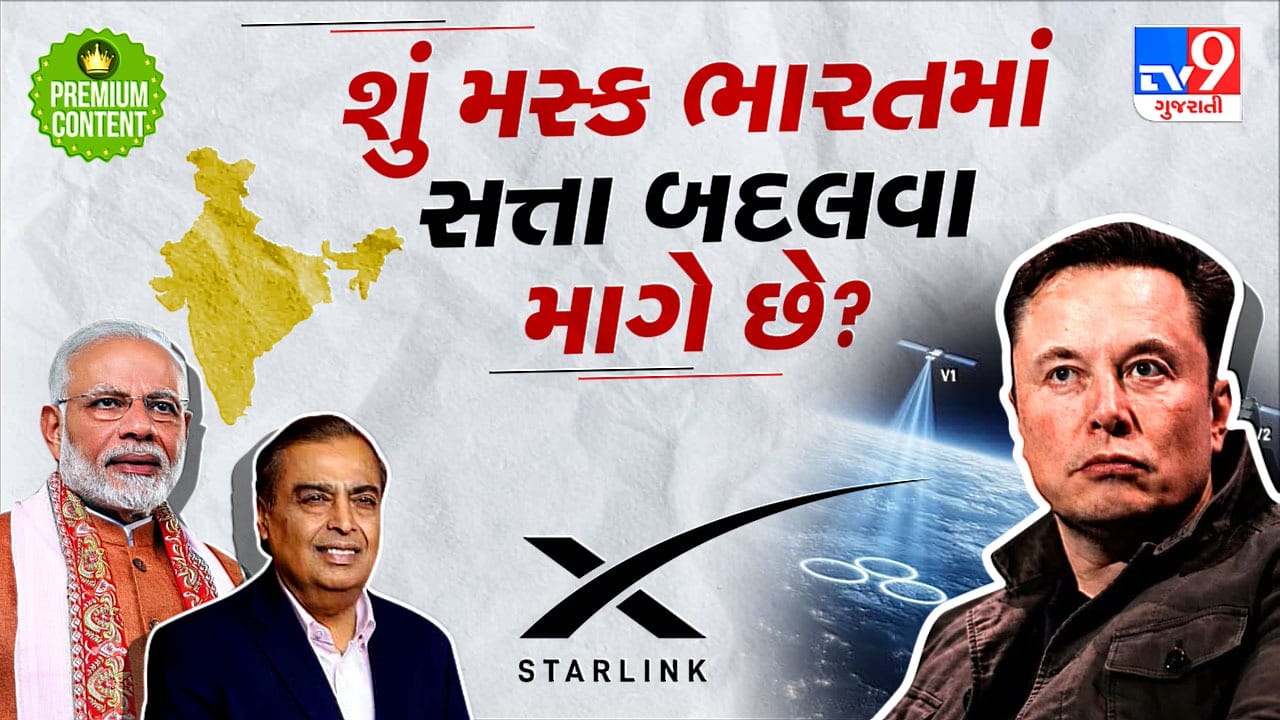
Recently on social media platform ‘X’, Elon Musk attacked India’s top businessmen Ambani and Mittal who owns a telecom company, writing that some rich (oligarchs) are not allowing Starlink to come to India to maintain their own interests and monopoly. Musk was directly pointing at Indian telecom leaders Mukesh Ambani (Jio) and Sunil Bharti Mittal (Airtel). At the ‘Indian Mobile Congress’ (IMC) held at Yashobhoomi Convention Center in New Delhi, Starlink Vice President Lorraine Dreyer also claimed that they have been waiting for government permission to launch the service in India for the last 5 years. But the dispute is not limited to the rivalry between the two business groups. Serious debates have now begun as to whether Musk’s early entry into India is only for commercial gain or there is a deeper angle of power change or political instability in India by Western powers.
Musk’s 2020 tweet “We can shift power wherever we want”
To understand the relationship between Elon Musk and Regime Change, one has to remember the event of 2020. In the year 2020, a situation of extreme political unrest and coup d’état arose in the South American country of Bolivia. At the time, when a user on social media asked Musk if the US government was adept at removing power from other countries, Musk openly replied, “We can change power wherever we want, whether you like it or not”. Although Musk later deleted the tweet, it made his mindset clear that he has the ability to intervene in any country’s politics with his technology and economic might. It is because of this statement that Starlink’s unrestricted entry into a dominant country like India is now viewed with suspicion.
Western countries and the use of Starlink as a geo-political weapon
Starlink is not just an internet provider, but it has become a powerful arm of geopolitics. Starlink terminals have been delivered by the US Department of Defense (DoD) to war-torn and troubled areas around the world. Musk’s Starlink network was instrumental in maintaining military communications in Ukraine during the Russia-Ukraine war. In addition, when anti-government protests broke out in Iran and the local government banned the Internet, Starlink devices were smuggled into Iran illegally to fuel the protests. Usually in any country the first government to shut down the internet is to stop rumours, riots or violence. But if a satellite network like Starlink is available, it can easily fuel attempts to change power within the country by spreading rumors without government control.
Claims of illegal Starlink devices being found in India are also behind the Manipur violence
There have been signs of this danger in India as well. In the year 2024, when ethnic unrest and violence were at its peak in the sensitive Indian state of Manipur, an illegally used Starlink device was seized by the local police. When Musk and his company were asked about this, they defended saying that they did not activate the signal (Beam) over India. But with Starlink services running in India’s neighboring Bangladesh and Myanmar, its signals were being picked up in border areas and being used to spread information despite government restrictions. This incident proves how big a threat it can be to national security and internal peace if satellite internet enters the country without the permission of the Indian government.
Use of ‘X’ and Occupy Global Narrative
Elon Musk bought Twitter (X) for a whopping $33 billion. The main motive behind this deal was not only to earn profit, but to dominate the flow of news and information (discourse) around the world. Twitter is a platform from which narratives and rumors spread rapidly on a global scale. Recently, an account named ‘Doge Designer’ posted that 11,256 villages in India do not have 4G, which Musk immediately re-tweeted to rail against the Indian system and businessmen. Musk can create a referendum against the government of any country using his social media platform. Additionally, anti-Indian or racist content on X is easily allowed to go viral and requests from the Indian government to remove it are often denied, indicating Musk’s policy towards Indian supremacy.
The issue of double standards and security of Western countries
America and western countries adopt a very strict attitude in the name of their security. Even in 2026, the US government has banned Chinese companies like Huawei and ZTE from the telecom sector, as well as boycotting Chinese unmanned robots and data centers in the name of security. The US believes that Chinese companies can steal the data of its citizens. But when countries like India demand licensing and data localization from Starlink as per their own internal security and laws, Musk and the Western media try to put pressure on the Indian government by labeling it as “pressure from oligarchs” or “restriction of free trade”.
Attitude of Government of India and priority of national security
In 2021, Elon Musk started extorting money from Indian customers on pre-bookings without seeking the approval of the Indian government. The Government of India strongly objected to this and stopped the pre-booking and refunded all the customers’ money. The government has clarified that Musk’s allegations are completely baseless. India’s licensing rules are non-discriminatory and the same conditions apply to each of Jio, Airtel or Starlink. The Prime Minister of the country has also mentioned that in today’s digital age, the security of the country’s military, citizens’ phones and networks is our top priority. If Starlink wants to come to India, it will have to give control and monitoring rights to government security agencies.
Business model or political game?
Musk claims that he wants to connect 11,256 villages without internet out of 6.5 lakh villages in India. But the reality is that Starlink’s hardware kit comes at ₹35000 and its monthly charges can range between ₹5000 to ₹8000. Villages where people use cheap internet cannot afford such expensive services. In the world’s largest democratic country like India, no foreign tech-giant can be allowed to arbitrarily or interfere in internal politics. If Starlink wants to do business in India, it has to follow India’s sovereign laws and national security measures.
Hindu Saint’s Entry on AI’s World Stage, Anthropic Now Invites Hindu Saint to Teach AI Lessons of Virtue – Video
. Source