





















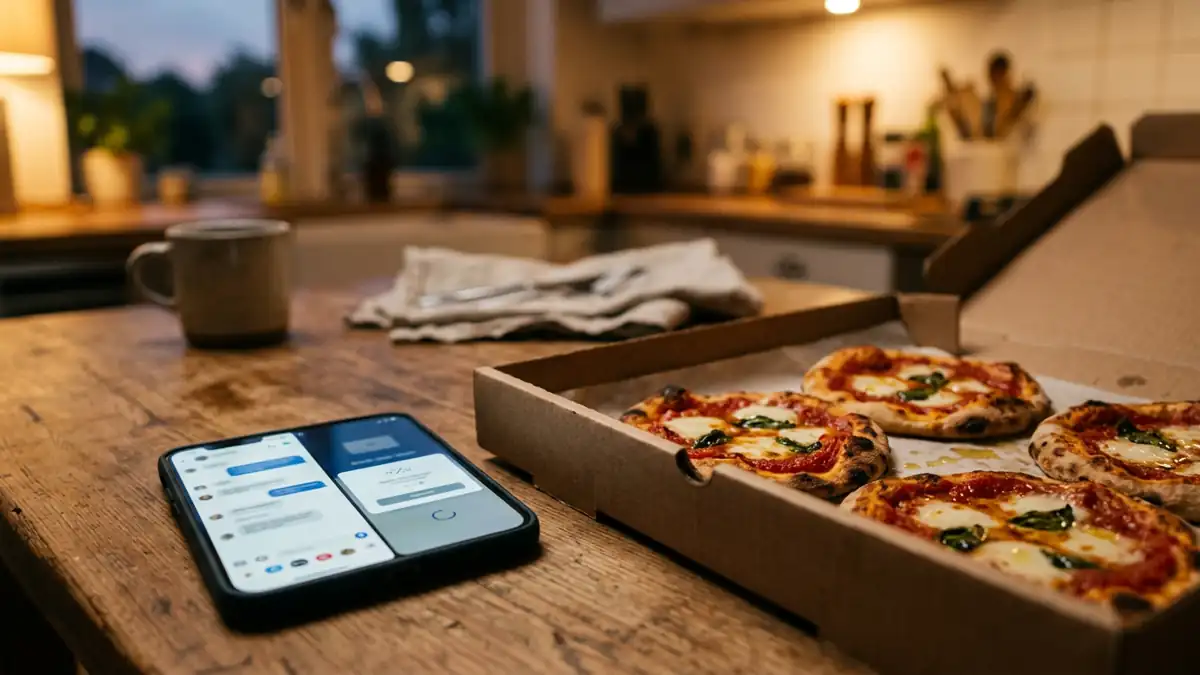
An AI agent has bought nine mini Papa John’s margherita pizzas for a real customer without a card number or bank password changing hands, in what TrueLayer says is the UK’s first cardless AI agent payment, completed on 26 November 2026 inside a Financial Conduct Authority sandbox.
Key points
- TrueLayer, a London-based open banking firm, says an AI agent paid a named UK retailer, Papa John’s, directly from a customer’s bank account for the first time.
- The order was nine mini margherita pizzas, placed in the Financial Conduct Authority’s regulated sandbox with Lloyds Bank.
- The agent worked under a bank mandate with a maximum spend per transaction and per month, and no account security details were shared.
- TrueLayer’s chief executive, Francesco Simoneschi, said the test was a first step towards mass adoption of agent-led shopping.
What happened with the AI agent pizza payment?
A customer chatted to Papa John’s own AI agent, described the occasion and dietary requirements, and was offered flavours and quantities. Once the order was confirmed, the agent paid straight from the customer’s linked bank account, the Guardian reported. The pizzas arrived later.
Mr Simoneschi told BBC Radio 4’s Today programme that the transaction had “no account numbers, no password” and was handled with “the highest possible security profile”. The value of the order was not disclosed.
In its announcement on 27 November 2026, TrueLayer said it worked with UK banks including Lloyds and NatWest, and that it was the first use of their variable recurring payment APIs for agentic payments. It shared its findings with the FCA and industry at the regulator’s showcase on 26 November.
How does cardless payment by an AI agent work?
The customer links a bank account to their Papa John’s account using open banking technology rather than entering a card. At that point they set a spending limit with their bank, which TrueLayer says no AI agent can exceed. Approval happens inside the bank’s own app, so credentials never reach the agent.
According to TrueLayer, the customer sets up the mandate once, choosing limits per merchant or over specific periods. The bank checks every payment against those limits and declines anything above them. The mandate can be cancelled with the merchant or from the banking app at any time.
| Feature | What TrueLayer and Lloyds described |
|---|---|
| Payment source | Customer’s linked bank account, not a card |
| Spending limits | Maximum per transaction and per month, set via the bank |
| Credentials shared with agent | None |
| Where it was tested | FCA regulated sandbox |
Why does it matter? Background on AI shopping agents
AI shopping assistants are arriving fast in Britain. Meta’s personal AI agent, Muse, launched in the UK on 24 November and, the Guardian notes, can also make purchases online, but it pays with a customer’s bank card. The bank-mandate route tested by TrueLayer is the alternative model: the limit is enforced by the bank rather than by the agent or the retailer.
The Guardian also reported that, earlier this week, the FCA warned financial services firms developing AI agents that they must comply with existing regulations. Mr Simoneschi said the sandbox was chosen to understand the technology before wide adoption.
What it means for you
You cannot yet pay for a takeaway this way: this was a controlled trial, not a product launch. But the design hints at what may come. If your bank enforces the limit, an agent that misreads your request cannot spend more than you allowed.
Mr Simoneschi said that if an agent made a mistake, such as ordering the wrong product, buyers would still be protected by existing rules covering consumer rights. He also stressed that “good judgment still applies”, and that people need control and supervision of what their agents do.
He predicted that “this is possibly the last Black Friday as we know it”, with agents buying gifts for people next year. That is a forecast from a company with a commercial interest in the technology, not a certainty. For related technology risk this week, see our report on the DWP cyber incident, and for more, visit our technology section.
Mr Simoneschi also said consumers would still need to make informed decisions about how they use AI agents for purchases, and that the underlying technology must be fit for purpose while meeting the highest security standards.
What happens next?
TrueLayer says the pilot informs the work needed to create the conditions and standards for adopting the technology safely at scale. No date for a public rollout has been given. Retailers, banks and the FCA will now weigh up the findings from the showcase held on 26 November 2026.