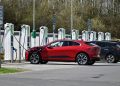






















Chaos on energy markets caused by the war in Iran is set to lumber EV owners with higher charging bills – but rocketing pump prices mean green vehicles will remain cheaper to run than petrol or diesel equivalents, experts have said.
Drivers of electric vehicles are immune to the price rises already hitting UK forecourts after the halt of shipments through the Strait of Hormuz on Monday saw oil prices hit $100 (£75) per barrel.
But EV charging costs are also expected to increase as an anticipated rise in electricity costs caused by the Iran crisis also feeds through in the coming months.
Analysts have predicted that the energy price cap – the mechanism used by the Government to limit domestic power costs – is likely to rise by about 10 per cent in July, after the Middle East war sparked a sharp rise in wholesale gas prices.
This would represent an increase of about £160 a year in the energy bill of a typical household, bringing it to £1,800 a year.
Frankie Mayo, senior UK analyst at Ember, an energy pricing think-tank, said a “serious rise” in energy prices is “already evident”.
He said: “Britain remains too reliant on gas for both power and heating, and consumers are already facing price rises in both power and vehicle fuel prices.”
‘Charging an EV at home will cost more’
A 10 per cent increase would wipe out a reduction in the energy price cap due to come into force in April and result in an increase in prices paid for charging EVs at home, depending on whether or not drivers already have fixed overnight EV tariffs used to lower charging prices.
One industry insider told The i Paper: “If the situation in Iran does not resolve in the short term, it is increasingly likely that the energy price cap will have to rise.
“That in turn means charging an EV at home will cost more. But the scale of that increase remains to be seen.”
A standard EV charge, which currently costs between £17 and £20, is set to fall by a little over £2 when next month’s price cap reduction is implemented. If that reduction is reversed in July, the price of an EV charge would be expected to increase by a similar amount.
Rapid charging stations face higher input costs
Despite advances in the installation of wind and solar power, Britain remains heavily reliant on gas for heating and power generation.
Around 30 per cent of the UK’s electricity comes from gas-fired power plants, compared with 17 per cent in Germany and just three per cent in France. This country also has less gas storage capacity – representing as little as two days of demand, compared to 90 days in Germany.
Consequently, experts say Britain is unusually susceptible to sudden fluctuations in global gas prices. An announcement by Qatar last week that it was halting gas production resulted in a 70 per cent spike in UK wholesale gas prices and, according to Ember, a 50 per cent rise in wholesale electricity prices.
Such rises could also feed through to the prices companies pay for electricity when operating rapid charging stations on motorways and at locations such as supermarket car parks. These charging stations cost around £40 to bring an EV battery from 10 per cent to the recommended full charge level of 80 per cent.
The industry source said a sustained rise in wholesale electricity prices would likely be passed on to motorists eventually in the form of higher prices at public charging points.
However, it is understood that the vast majority of EV charging operators, including major oil companies such as Shell and BP, operate on rolling 12-month deals with their electricity costs fixed for the duration of the contract. As a result, the timing and scope of any increases are difficult to predict.
Analysts also pointed out that the price advantage in fuel costs enjoyed by EVs over petrol or diesel vehicles is likely to widen as oil prices rise.
Petrol prices have already risen by 5p per litre to 137.5p and diesel by 9p to 151p per litre in the last two weeks. The RAC yesterday predicted that a sustained period of oil costing $100 a barrel or more would see petrol hit 150p per litre and diesel 180p.
The Energy and Climate Intelligence Unit, a UK-based environmental think-tank, said the result would be that EVs become even cheaper to run than petrol or diesel cars.
Colin Walker, the organisation’s transport analyst, said: “At present, EVs are already over £870 a year cheaper to charge than a petrol car is to fuel. Were the price of a barrel of oil to jump to $100, those savings would jump to over £1,000 a year. Were a barrel of oil to hit $120, they would jump to almost £1,200 a year.”
Such savings could be dented, however, under plans by the Government to introduce a new pay-per-mile road tax for EVs, predicted to cost owners about £270 extra a year.