














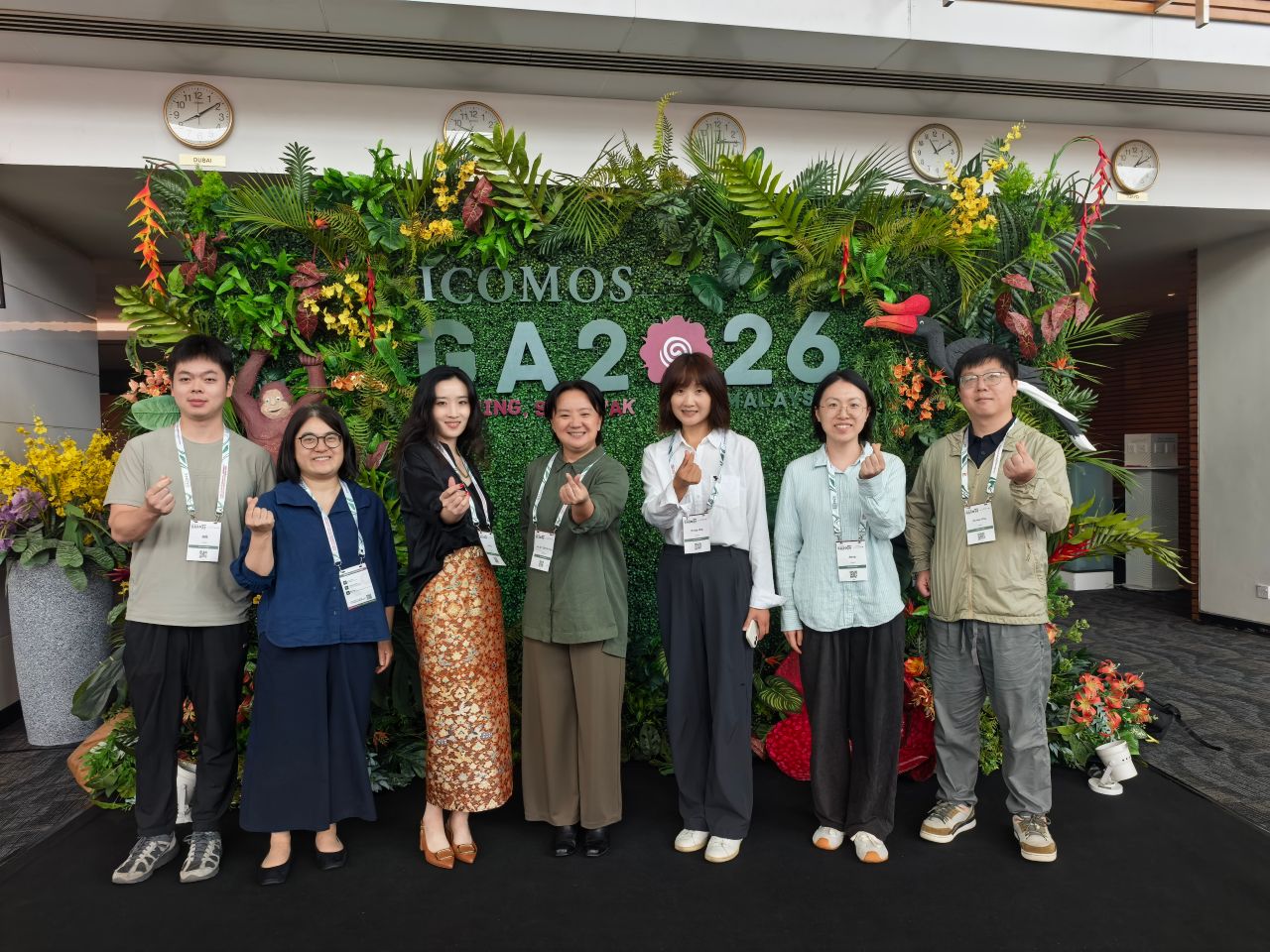
From October 15 to 24, the 2026 International Council on Monuments and Sites (ICOMOS) General Assembly—the 22nd ICOMOS General Assembly and Scientific Symposium—is being held in Malaysia under the theme “Living Heritage: Respect, Enhance, Accept, Partner.” Held every three years, it is ICOMOS’s largest and highest-level gathering. On October 20 and 21, with the support and guidance of the Sichuan Provincial Cultural Heritage Administration, six young scholars from Sichuan presented at the assembly’s academic sessions, exchanging insights with cultural heritage conservation experts from more than 100 countries and sharing Sichuan’s approaches to cultural heritage conservation.
Key Breakthroughs in Conservation
Hu Rui and Dou Zichao, a research officer and an assistant research officer at the Sichuan Provincial Institute of Cultural Relics and Archaeology, shared their experience applying soft-capping techniques to exposed earthen sites in southern China, using the city walls at the Sanxingdui Site as a case study. According to Dou, the team developed a solution tailored to the region’s humid climate, integrating consolidation and repair, soft-capping protection, and harmony with the surrounding landscape.
Jiang Luman, an associate research fellow at the Chengdu Institute of Cultural Relics and Archaeology, presented over 40 years of ivory conservation achievements. Her paper, “Development and Demonstration of Key Technologies for Dehydrating and Consolidating Excavated Waterlogged Ivory: Practices at the Sanxingdui and Jinsha Sites,” outlined methods enabling long-term preservation and display. Treated ivory has been exhibited at several museums, including the National Museum of China.
Pathways to Sustainable Heritage Conservation
Zhao Yun, an associate research fellow at the Chengdu Institute of Cultural Relics and Archaeology, introduced a “Sichuan model” integrating tangible and intangible cultural heritage through the restoration of traditional chuandou timber-frame buildings. Combining extensive field surveys with systematic research, this approach connects historic structures, craftspeople, traditional skills, and management bodies to support the sustainability of architectural heritage.
Qu Jin, an associate research fellow at the Chengdu Jinsha Site Museum, highlighted how urban development and rainfall jointly affect local groundwater dynamics, threatening heritage sites in cities. She stressed that monitoring within site boundaries alone is insufficient and called for broader hydrogeological assessments to better safeguard these sites.
Dong Jing, an associate research fellow at the Sanxingdui Museum, described its collaboration with the Sichuan Provincial Institute of Cultural Relics and Archaeology to pioneer digital interpretation at archaeological excavation sites using virtual reality (VR), augmented reality (AR), and mixed reality (MR). The excavation-site VR experience has attracted over 120,000 visitors and won multiple industry awards. It demonstrates a successful approach to presenting earthen sites sustainably while strengthening public engagement with cultural heritage in the digital age.
Sharing their work with over 1,800 experts from more than 130 countries, the six scholars showcased a “Sichuan model” spanning earthen-site conservation, artifact preservation, architectural restoration, environmental monitoring, and digital interpretation. Their contributions reflected the assembly’s “Living Heritage” theme and offered Chinese expertise to help sustain cultural heritage for future generations.