














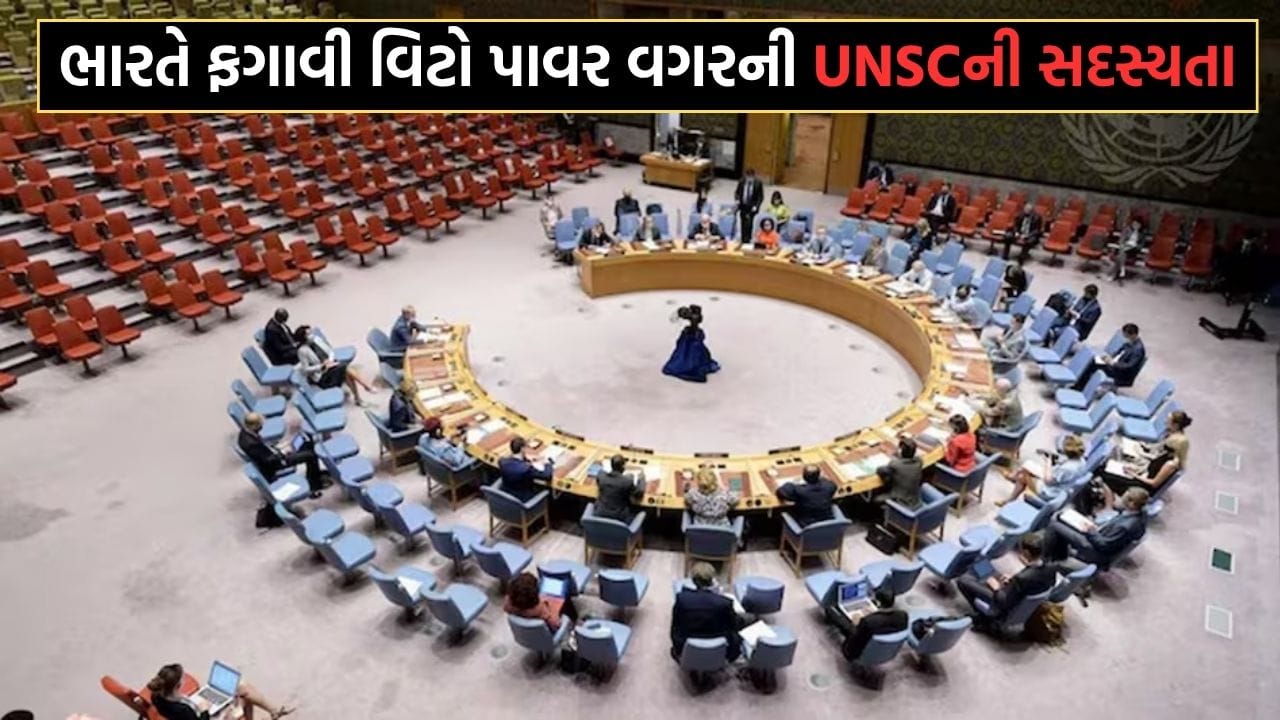
The main attraction of being a member of the United Nations Security Council (UNSC) is the veto power. Veto power is what gives its members the right to decide whether or not any decision made by the UNSC will be implemented. India is emerging as a major power in the world, and India has been trying to get permanent membership in this Security Council for a long time now.
But India has categorically rejected any such proposal amid debate over permanent membership without veto power. Ambassador Harish Parvathaneni, India’s permanent representative to the UNSC, made it clear that permanent membership without a veto is tantamount to ‘second class’ status. And India will not accept it
Speaking on the ‘Question of Veto’ during the plenary session of the Inter-Governmental Negotiations at the United Nations General Assembly on Monday, Ambassador Parvathneni said, “As long as the veto provision exists, all permanent members of the Security Council should have this right. Justice and fairness demand that all permanent members have equal rights and responsibilities.”
“It is well known that India’s stand on veto is principled. We reiterate that as long as there is a provision for veto, all permanent members of the post-reform Council should have this right,” he said.
The creation of a new category of non-veto long-term members under the Security Council reforms would make them second-class members, Parvathneni said. It consists of P5 (5 standing members).
Parvatheneni said that by creating a “new category of long-term members without veto power” as part of Security Council reforms, they would in effect become ‘second-class’ members. This will not change the decision-making process of the P5 (five permanent members).
He further said that establishing a new category of permanent members, whether or not they have veto powers, would further confuse an already complex debate. This would “deepen the inequality that we want to eliminate.”
“The concepts of periodic elections and permanent membership are fundamentally at odds with each other,” said India’s ambassador.
“History teaches us a lesson,” he remarked. He recalled that when the Security Council was expanded in 1965, the number of non-permanent members was increased from 6 to 10, while the number of permanent members remained at 5.
Parvatneni noted that this changed the ratio of permanent and elected members from 5:6 to 5:10, thereby strengthening the position of the ‘P5’ (five permanent members).
The Indian diplomat emphasized that the issue of limiting the veto cannot be considered in isolation from other aspects of Security Council reform such as membership categories, regional representation, size of the Council and its functioning.
“India reiterates its demand for a comprehensive approach to Security Council reforms. The process should begin with negotiations based on written proposals, which should include clear time frames and defined objectives,” he said.
Discussing the Council’s procedure, India said the “veto” was not limited to votes formally cast by permanent members.
India’s claim for non-permanent membership
India has consistently advocated for membership expansion in both permanent and non-permanent categories. Furthermore, India has warned that if reform efforts are limited to increasing the number of non-permanent members, it will in fact be considered a failure.
New Delhi has been at the forefront of long-standing efforts to reform the Security Council. India believes that the organization established in 1945 is not fit for the 21st century and fails to reflect the current geo-political realities.
India has repeatedly asserted that it is fully entitled to a permanent seat on the Security Council.
Besides, India is trying to get a non-permanent seat for the 2028-29 term. Elections for this term are due to be held in June next year, with India and Tajikistan competing for the sole seat allocated to the Asia-Pacific bloc.
Prerogatives of veto power in the Security Council
The five permanent members of the United Nations Security Council (US, Russia, China, Britain and France) have exclusive right of veto power. It allows any permanent member to single-handedly veto any important motion even if the other 14 countries are in its favour.
This power mainly applies to matters of international peace, security and sanctions, authorizing military action and admission of new members.
These countries have significant influence on the Council because of the veto. They can protect their national interests, allies and sensitive issues. This gives them extraordinary political weight and influence over other members, making their concurrence in decisions of the Council indispensable.
Now the cars will run on E100 fuel instead of petrol, the government has paved the way for E100 fuel cars, know which cars will run?
. Source