














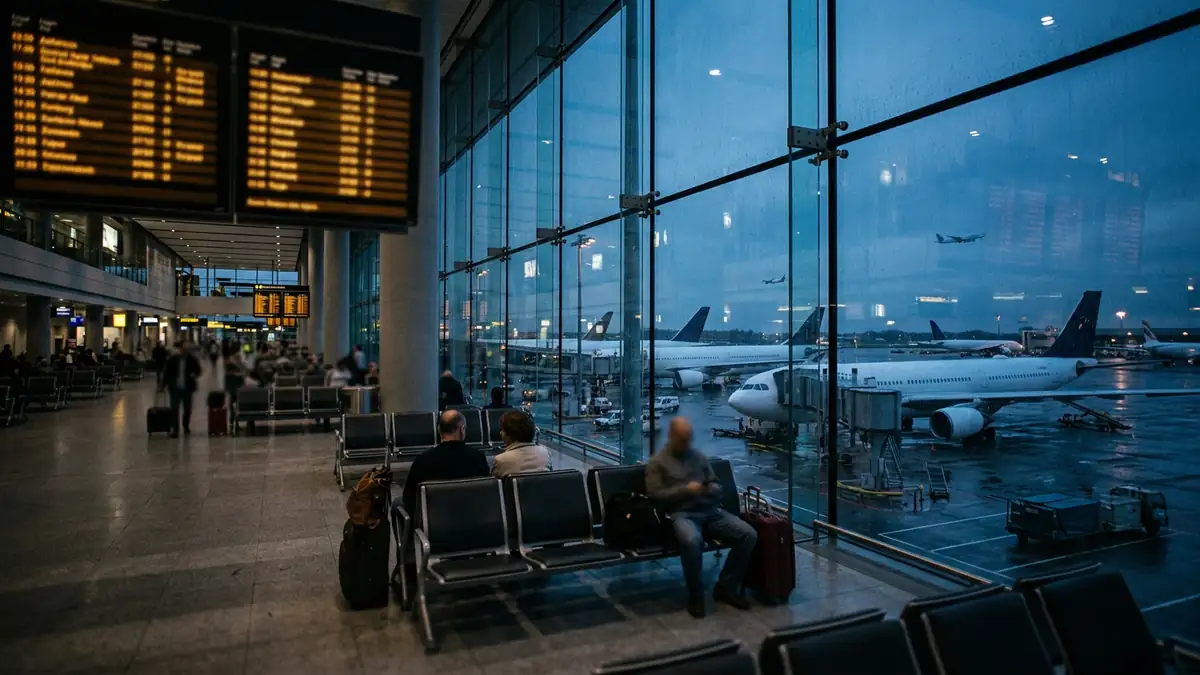
The US ground stop that froze American airspace on Friday has rippled across the Atlantic, cancelling and delaying flights at Heathrow and Manchester and leaving British travellers asking who pays when a single faulty router can halt the world’s busiest aviation market.
For a little over four hours on Friday 13 November, almost nothing took off in the United States. The Federal Aviation Administration (FAA) ordered a nationwide halt to departures shortly before 4pm on the US east coast, in what officials and analysts have described as the longest such shutdown since the September 11 attacks in 2001. Although American airspace reopened at 8.15pm Eastern time that evening, the knock-on effect on aircraft, crews and passengers spilled through the weekend and onto services linking the UK with North America.
What caused the US ground stop?
The cause, it emerged, was not a cyber-attack but routine engineering work that went badly wrong. In a question-and-answer briefing published on Sunday, the FAA said its legacy equipment became unstable when data began flooding its telecommunications network at a rate of around 1,000 connection attempts every four to five seconds, disrupting communication with aircraft and radar feeds.
The regulator said its initial investigation pointed to two sites – a radar facility in Amarillo, Texas, and a radio communications site in El Dorado, Arkansas – where its network provider, L3Harris, had been working, including installing a new router. Instability spread to 17 of the FAA’s 22 air route traffic control centres, the large facilities that manage aircraft at cruising altitude. As a precaution, the agency said it had disabled the same broadcasting function on about 60 similar routers across the system.
US Transportation Secretary Sean Duffy told reporters the fault arose as old copper lines were being switched to fibre. According to Reuters, he said officials were still working out whether the problem was “user error or installer error” or a faulty router. L3Harris has said it takes the disruption seriously and is supporting the FAA’s investigation.
How badly were UK flights hit?
The scale of disruption inside the US was enormous. Reuters, citing FlightAware, reported about 9,200 cancellations and 7,500 delays on Friday, followed by more than 6,400 cancellations and over 8,000 delays on Saturday. The FAA’s own figures put Friday’s cancellations at roughly 12,462, though it noted that not all were directly caused by the stoppage.
For Britain, the effect was narrower but real. The BBC reported that all US-bound traffic from the 42 Eurocontrol member states, including the UK, was suspended while the ground stop was in force. A number of US flights from Heathrow were cancelled or delayed, while Manchester Airport said it did not expect significant disruption and Gatwick operated normally.
Passenger rights firm AirHelp said Heathrow’s 8.20am Saturday departure to Dallas/Fort Worth was among the cancellations and that three Virgin Atlantic departures from Manchester were affected. British Airways warned that flights leaving the US could face delays and advised customers to travel to the airport as planned.
Your rights if your flight was cancelled or delayed
The uncomfortable news for affected travellers is that cash compensation is unlikely. Under the UK’s version of the EU261 rules, airlines owe fixed compensation only when a disruption is within their control. An air traffic control failure on another continent is a textbook “extraordinary circumstance”.
That does not leave passengers empty-handed. For flights departing the UK, or operated by a UK or EU carrier, airlines still have a duty of care. As the BBC set out, that includes reasonable food and drink, a means of communication, and overnight accommodation with transport if a passenger has to wait until the next day. Where an airline cannot arrange this, travellers may book reasonable alternatives and claim the cost back later; the Civil Aviation Authority advises keeping receipts and not spending more than necessary.
Those whose flights were cancelled are also entitled to choose between rerouting and a full refund. In the US, the FAA Reauthorization Act of 2024 requires airlines to offer a refund where a flight is cancelled or significantly delayed – six hours for international routes – if the passenger chooses not to travel. Reuters reported that several US carriers issued waivers allowing passengers to rebook later dates at no extra cost.
A warning for the busy winter travel season
The episode lands at a sensitive moment. Christmas and New Year are among the busiest periods for transatlantic travel, and Friday’s failure has put the fragility of the American system under an unflattering spotlight. Mr Duffy has called for $50bn to overhaul US air traffic control, and the FAA has said it will reconsider whether replacement and maintenance work should be carried out during the day.
Britain is hardly immune to similar problems. The UK suffered its own major air traffic control failure in August 2023, when a NATS flight-planning fault caused widespread cancellations, a reminder that ageing, tightly interconnected systems on either side of the Atlantic can fail in unexpected ways. For travellers, the practical lessons are simple: check flight status before leaving for the airport, keep every receipt during a delay, and consider travel insurance that covers disruption costs beyond what airlines must pay.
The FAA insists the system is now stable and that every aircraft in the air during the stoppage landed safely. Whether that reassurance holds through the festive peak may depend on what investigators find inside two routers in Texas and Arkansas.
For more on getting around this winter, see the latest from London Journal Travel.