

















Europe’s Euclid space telescope has published its first major haul of survey data, a catalogue of more than a billion cosmic objects captured with a camera designed and built under British leadership, and the opening chapter of what is intended to become the most detailed 3D map of the universe yet made.
The release, called DR1-Foundation, went public on 12 November. It covers roughly 13 months of observations made between spring 2024 and spring 2025 and spans about 1,900 square degrees of sky, an area equivalent to some 9,500 full Moons, according to the European Space Agency. All told, the package weighs in at around 1.7 million gigabytes.
Professor Carole Mundell, ESA’s Director of Science, called it “a scientific milestone” and “the largest space-based survey of its kind”.
What the Euclid space telescope has found so far
The headline numbers are staggering. ESA says the dataset contains more than 900 million galaxies, over 60 million candidate quasars (the blazing cores of distant galaxies powered by feeding black holes), and spectra for more than 160 million sources. Those spectra, which split light into its component colours, are how astronomers will work out how far away each galaxy is, the key step in turning a flat picture into a three-dimensional map.
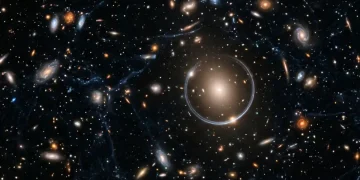
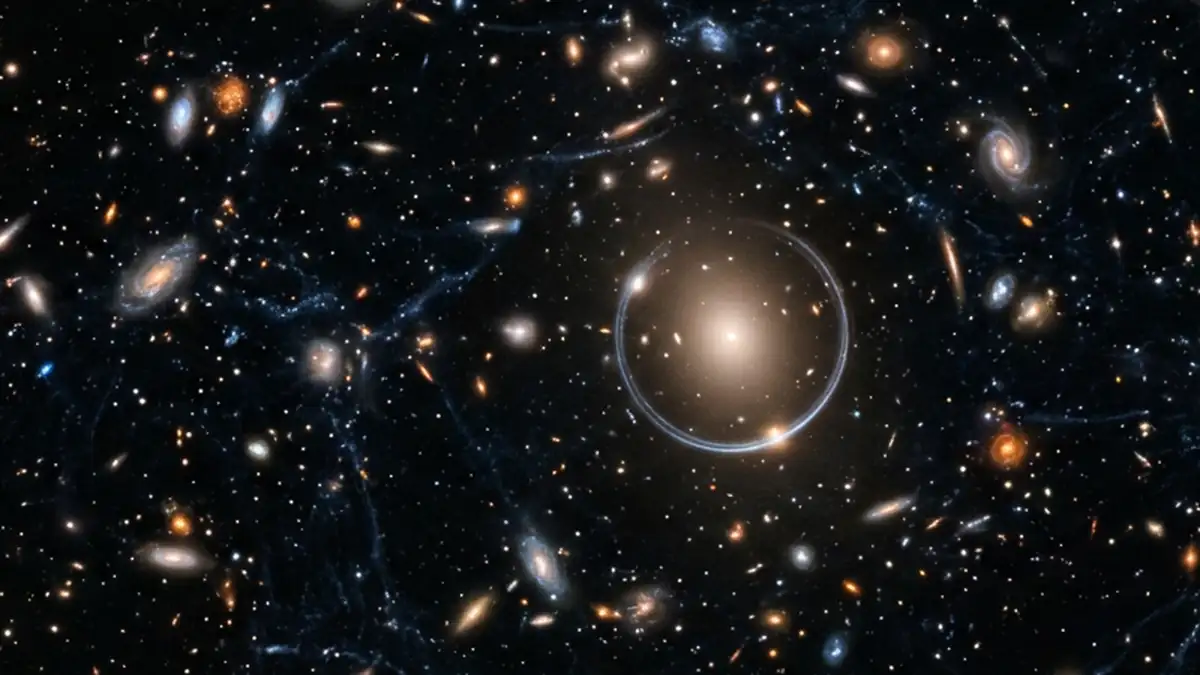
Perhaps the most eye-catching result is a catalogue of around 15,000 candidate strong gravitational lenses. These form when a massive foreground galaxy bends the light of a more distant one into arcs or even complete rings. They are rare, with only one galaxy in several thousand acting as a lens, and ESA says this single catalogue is larger than all previous ones combined.
Finding them took a mix of machine learning and human eyes: thousands of volunteers helped to sift the imaging through the Space Warps citizen science project on Zooniverse.
The British camera behind the sharp images
For UK science, the release carries particular weight. Euclid’s visible-light camera, known as VIS, was designed and built by an international team led from the Mullard Space Science Laboratory at University College London, UCL said.
Professor Mat Page, the VIS instrument lead, said the images were “amazingly sharp” and described the release as “a gold mine for astronomical discovery”. For objects such as strong lenses, which need extremely crisp images to spot, he said the data “blows away anything that’s ever come before”.
Saeeda Awan, a VIS system engineer at the laboratory, explained that the instrument’s images are so large they must be compressed on board before being beamed to Earth, then unpacked on the ground without losing a single bit of information.
British researchers are also prominent in the science. Natalie Lines, of the University of Portsmouth, told ESA that strong lensing lets astronomers “weigh” individual galaxies, including their invisible dark matter, and noted that her colleagues had forecast more than a decade ago that Euclid would transform the field. “That day is finally here,” she said. At UCL, Professor Benjamin Joachimi and Nicolas Tessore are leading strands of the data processing and analysis for the next, fuller release.
Why the dark universe matters
Euclid’s real purpose is to tackle two of the biggest puzzles in physics. Ordinary matter, the stuff of stars, planets and people, makes up only a small fraction of the cosmos. The rest is attributed to dark matter, which cannot be seen but exerts gravity, and dark energy, the mysterious influence thought to be speeding up the expansion of the universe.
By charting where galaxies sit across billions of light-years and how their light is subtly distorted on its way to us, Euclid aims to trace the hidden scaffolding known as the cosmic web, a network of filaments made mostly of dark matter, and to measure how it has grown over the last 10 billion years of cosmic history. Comparing that growth with the predictions of current theories is one of the clearest ways to test whether our understanding of gravity and dark energy holds up.
Only the beginning
Large as it is, DR1-Foundation covers only about 14 per cent of the sky area Euclid will survey over its six-year mission. ESA says the complete Data Release 1 will follow in mid-2027, adding measurements of weak lensing, the faint, statistical distortion of millions of galaxy shapes, along with calculations of how galaxies and clusters fit into the cosmic web.
The mission launched in July 2023 and began routine science observations in February 2024. It is led by ESA with contributions from its member states and NASA, while the Euclid Consortium, more than 2,000 scientists from 300 institutes across 15 European countries, the US, Canada and Japan, supplied the instruments and runs the science analysis. The data is freely available to researchers through ESA’s Euclid Data Space platform.
For a country whose space ambitions are often measured in launch sites and satellites, the release is a reminder that some of Britain’s most valuable contributions come in the form of instruments and expertise. Follow more space and discovery stories in our Science section, and the latest innovation news in Tech.