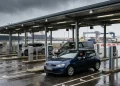














Eurotunnel biometric checks are set to look more like an airport e-gate than a traditional border post, after Brussels and Paris cleared a two-year trial that lets British drivers give fingerprints and facial images without leaving their cars at Folkestone and Calais.
The breakthrough, first reported by the Guardian at the weekend, offers a potential way out of one of the most persistent worries for cross-Channel travellers: that the EU’s long-delayed entry/exit system (EES) could trigger miles of tailbacks on the approach to the Channel Tunnel. Under the plan, police will supervise biometric enrolment remotely through camera systems rather than standing at every lane.
How the drive-through Eurotunnel checks will work
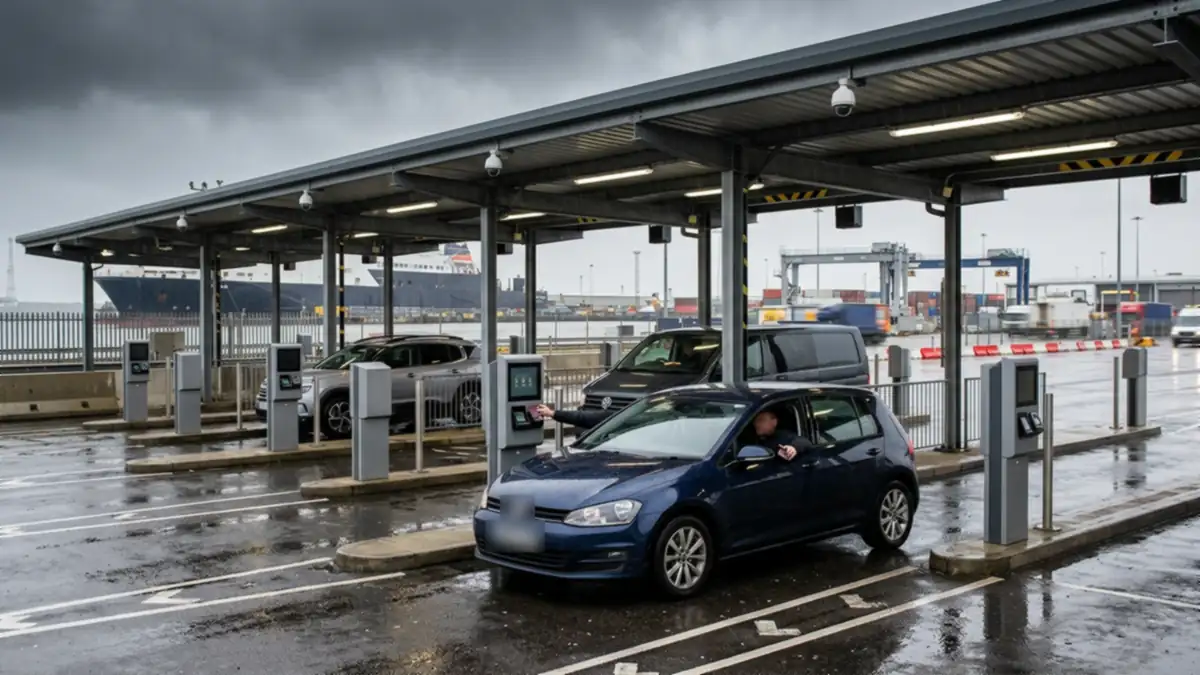
According to the Guardian, the European Commission has agreed to the use of an “eagle eye” camera system at the UK-France border – technology already used at airports in Rome and Paris to oversee fingerprinting and facial imaging.
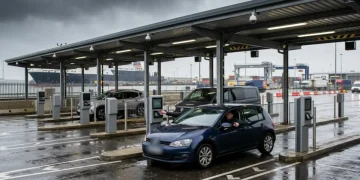
Both the Folkestone and Calais terminals are now equipped with 120 kiosks, each watched by a camera monitored by police, in much the same way that officers oversee banks of e-gates at airports without standing beside each one. Every car will pull up to its own kiosk, with two stands per vehicle to read passports and capture fingerprints and facial images.
Yann Leriche, chief executive of Eurotunnel owner Getlink, told the paper the company had set out to replicate the “airport experience” and then go further. He said the firm drew inspiration from the US-Mexico border, where drivers and passengers remain in their vehicles. The trial is due to run for two years, though Getlink hopes it will become permanent.
Why the old plans risked chaos
EES requires non-EU nationals, including British passport holders, to register fingerprints and a facial image when they enter and leave the Schengen area. For airports, that means kiosks in terminal halls. For a car-carrying rail shuttle, it has long been a logistical headache.
Getlink had previously considered handing tablets to passengers in their cars so they could scan themselves, or asking travellers to park and walk into a terminal building. Both options would have needed police officers physically present for first-time enrolments – known as “primo” registrations – a safeguard intended to stop people using someone else’s fingerprints. Mr Leriche said he warned authorities that such an approach would be “a mess”, with officers forced to move from place to place at peak times.
Remote camera supervision is designed to solve that problem, keeping the safeguard while removing the need for an officer at every car window.
When will British drivers notice a change?
That remains the crucial unknown. Mr Leriche told the Guardian he had no idea when France would switch the system on, saying the kiosks were in place and could function but the connection with the French system was still not working.
The wider rollout of EES has been troubled. It began in October 2025 and was meant to be operating fully across the EU by 9 September this year, but the Guardian reports that nine of the 27 member states, including France, have yet to deploy it fully because of technical issues. In September the paper reported that kiosks bought by Eurotunnel, the Port of Dover and Eurostar at St Pancras were still not operational, and that car drivers at Dover had yet to face EES checks.
Meanwhile, the EU’s IT agency, eu-LISA, has filed a lawsuit against IBM, Atos and Leonardo, the consortium behind EES, over delays during the system’s development. The agency said the case concerns the development phase and has no impact on current operations. Elsewhere, travellers at some airports have reported waits of up to three hours at peak times since the launch.
What it means for your next trip to France
For now, motorists using Le Shuttle should expect border procedures to stay as they are until French authorities give the go-ahead. When EES checks do arrive at the tunnel, the first crossing after the change will take longest, because each traveller must enrol their biometrics. Subsequent trips should be quicker, as details are stored and checked rather than captured from scratch.
The trial also matters beyond Kent. Mr Leriche plans to present UK and French officials with a 40-page proposal for Eurotunnel to act as a “laboratory” for an “intelligent border”, drawing on lessons from the US and Singapore. If drive-through enrolment works at Folkestone and Calais, it could become a model for other vehicle crossings struggling with the same problem.
The development comes as relations between London and Brussels are again in the headlines, with Andy Burnham set to tell a City audience that Brexit “has not worked”. For holidaymakers, though, the immediate question is simpler: whether the next Channel crossing will be smooth. A sensible approach is to allow extra time, carry valid passports for everyone in the car, and follow London Journal Travel for updates.