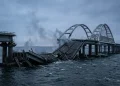



















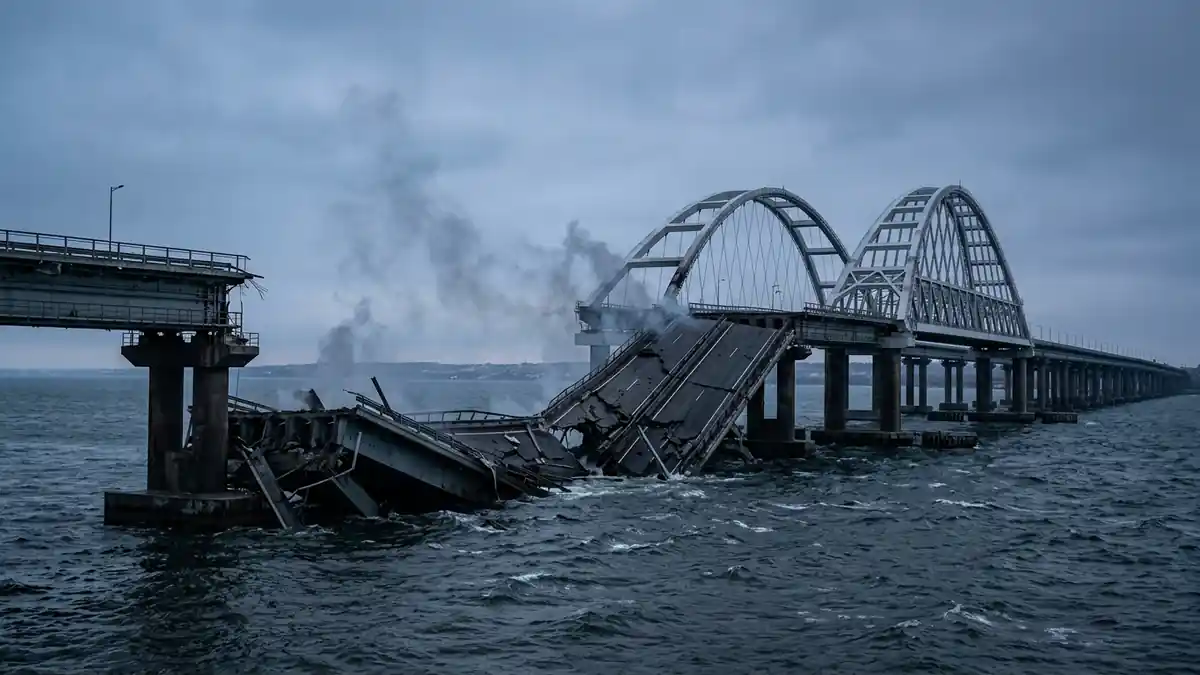
The Crimean bridge strike that Ukraine carried out overnight into Tuesday 17 November 2026 has brought down a central road span of the 19km crossing linking Russia to occupied Crimea, closing it to vehicles. The attack, which Volodymyr Zelensky called “unprecedented”, landed two days before Vladimir Putin is due to sit down with Donald Trump and Xi Jinping in Shenzhen.
Footage released by Ukrainian officials and verified by Reuters showed the main road arch over the Kerch Strait lying in the water, leaving a wide gap in the carriageway. Ukraine’s military said the roadway was “out of action”, with no vehicle able to cross, while the parallel railway bridge was still standing but had a damaged arch. Russia’s transport ministry said limited traffic would resume on a single rail track.
Sergei Aksyonov, the Russian-installed head of Crimea, said two people had been killed and that road traffic had been suspended. It was the second Ukrainian attack on the crossing in two days: a drone strike in the early hours of Monday caused what the Kremlin then described as minor damage.
What happened to the Crimean bridge?
Zelensky said the strike was the final phase of a seven-stage operation in which Ukrainian forces spent weeks wearing down Russian air defences, radars and electronic warfare equipment on the approach to the target. He listed a long roster of Ukrainian-made weapons, among them Palianytsia drones, which he said hit the road section, and Neptune, Ruta and FP-5 Flamingo missiles fired at the railway section.
“Russia strikes our infrastructure every day, including bridges,” Zelensky said. “We are restoring our infrastructure. But we are also reminding Russia that war will always return to where it began.” Ukraine’s SBU security service said one of the metal arches and the road span beneath it had been completely destroyed.
The Kremlin played down the long-term impact. Spokesman Dmitry Peskov said a repair plan would be drawn up and the bridge would be “even better than before”, and Russia’s Investigative Committee opened a criminal case on terrorism charges. Deputy prime minister Marat Khusnullin said a government commission had met to assess the damage and organise alternative routes for cargo.
The strike came as Russia hit back at Ukraine’s own crossings. Kyiv’s mayor, Vitali Klitschko, said Russian missiles struck the city’s North and South bridges over the Dnipro, partly damaging the metro and cutting some water, heating and power supplies, the BBC reported.
Why the Kerch bridge matters to Putin
The crossing is far more than a piece of logistics. Built after Russia illegally annexed Crimea in 2014 and opened by Putin himself in 2018, it has become a symbol of Moscow’s claim to the peninsula. Ukraine has hit it before: a truck bomb in October 2022 killed four people, and a road section was destroyed in July 2023.
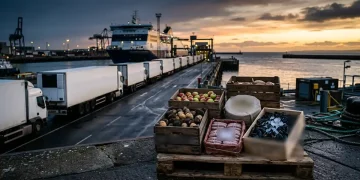
This time the damage looks far heavier. Finnish military analyst Emil Kastehelmi wrote that the road bridge “won’t be repaired during this war”, according to Reuters. Russia’s military already leans more heavily on a land corridor through occupied southern Ukraine, and there is a ferry across the strait, though its capacity is limited. Both are exposed to Ukrainian drones, and Kyiv has spent the past month striking bridges and roads in the north of the peninsula.
How the UK responded to the Crimean bridge strike
Britain was quick to back Kyiv. Arriving in Brussels to co-chair the Ukraine Defence Contact Group with Germany’s Boris Pistorius, Defence Secretary Wes Streeting called the attack “another example of Ukrainian ingenuity and Ukraine’s absolute determination to defend itself against Russian aggression”, adding: “We stand with Ukraine, as they do that.” Nato secretary general Mark Rutte said hitting logistical nodes was “unavoidable” for a country defending itself.
Streeting also used the meeting to announce a £240 million air defence package, which the Ministry of Defence said includes more than 1,000 short-range air defence missiles and launchers, partly built by Thales in Belfast, and more than a dozen radars. Deliveries are due to begin in mid-December. The package is part of £500 million for Ukraine this winter announced at the Budget. The UK, Sweden and Ukraine also signed a letter of intent on supplying Swedish Gripen fighter jets, more than 30% of each of which, the MoD said, is made in Britain.
What it means for the UK and what happens next
For British readers, the immediate stakes are diplomatic. The strike gives Kyiv leverage, and embarrasses Putin, just before Thursday 19 November, when he meets Trump and Xi in Shenzhen and European leaders gather in Berlin for a coalition of the willing meeting at which, the government said, the Prime Minister will set out the rest of Britain’s winter support. Streeting said any settlement must be “on terms that are acceptable to Ukraine”, insisting there can be “no decision about Ukraine without Ukraine”.
There is also a slower-burning economic thread. The bridge spans the channel ships use to enter and leave the Sea of Azov, and Andrey Sizov of the consultancy Sovecon told Reuters its collapse could “substantially delay” any resumption of grain shipping from the area, because debris will have to be cleared first. Black Sea grain trade has already largely stalled, and any further disruption feeds into the global food markets that shape prices on British shelves. That comes as tensions in the Gulf are already weighing on energy, as London Journal reported on Monday.
The key questions now are how quickly Russia can restore even partial road access, whether the damaged rail arch holds, and whether the bridge features in the Shenzhen talks. Follow the latest on London Journal’s World news page.