


























The most distant quasar ever found has been discovered by the European Space Agency’s Euclid space telescope: a galactic core powered by a black hole of about 360 million Suns, seen just 630 million years after the Big Bang, ESA announced on 24 November 2026.
Key points
- The European Space Agency’s Euclid telescope has found the most distant quasar known, J1504+6252, nicknamed Dún Aonghasa, at a redshift of 8.13.
- Follow-up observations with the James Webb Space Telescope showed it is powered by a black hole of roughly 360 million solar masses.
- It breaks Euclid’s own record, announced only months earlier, by 40 million years of cosmic history.
- The study by J. Wolf and colleagues is published in Astronomy & Astrophysics on 24 November 2026.
What is the most distant quasar ever found?
The most distant quasar known is J1504+6252, nicknamed Dún Aonghasa, according to the European Space Agency (ESA). A quasar is an intensely bright galaxy core powered by gas falling into a supermassive black hole, releasing enormous amounts of energy as it does so.
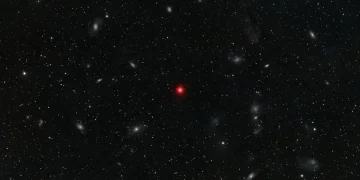
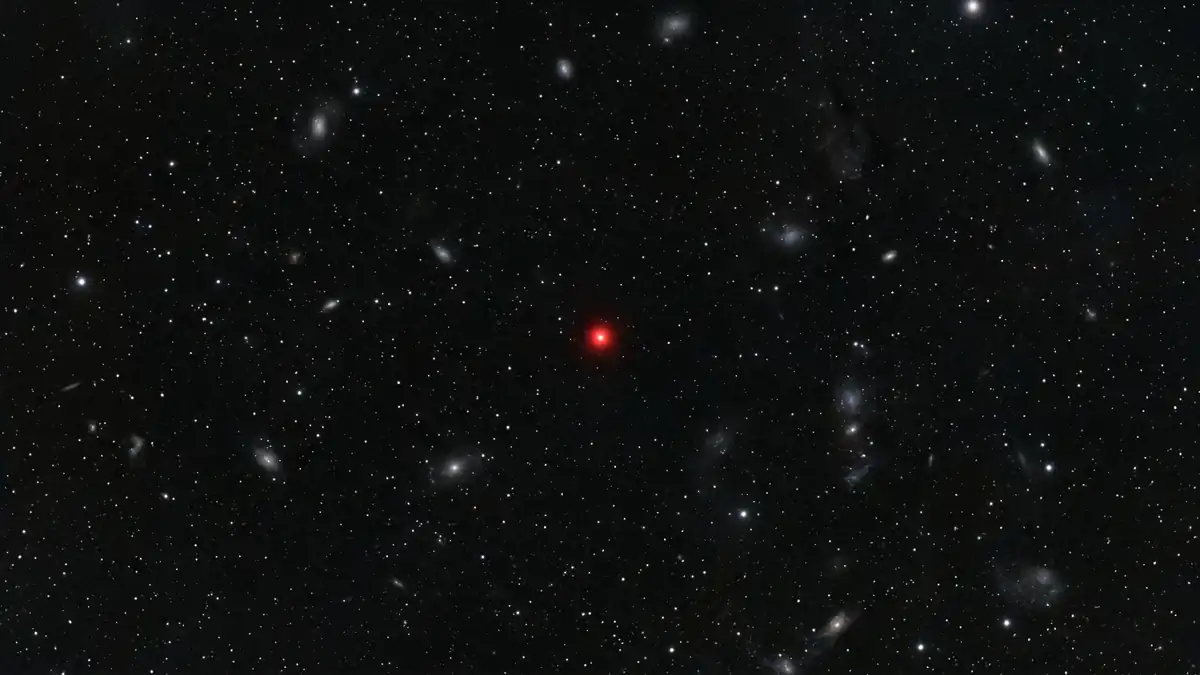
Dún Aonghasa is the first quasar identified beyond a redshift of 8, at 8.13. ESA says that corresponds to the Universe as it was roughly 13.1 billion years ago, when it was just 5% of its current age. The object appears as a small red dot in Euclid’s image, picked out from millions of sources in about 18 months of data.
How was the quasar confirmed?
Confirming the quasar took a campaign across several observatories. ESA said the W.M. Keck Observatory, the Large Binocular Telescope Observatory, the NASA/ESA Hubble Space Telescope and finally the NASA/ESA/CSA James Webb Space Telescope all took part in follow-up work to establish what the red dot was.
It was Webb that revealed the black hole’s mass, at about 360 million Suns. The result is described in a paper, “Euclid: Discovery of a quasar at z = 8.13 quasar hosting a 360-million solar-mass black hole”, led by J. Wolf and published in Astronomy & Astrophysics.
Why is such a huge black hole so early a puzzle?
The black hole is a puzzle because it is enormous for so young a Universe. ESA says Dún Aonghasa is unusual among distant quasars in consuming material at a relatively slow rate, which means it must have reached its vast mass through extremely rapid growth episodes very early in cosmic time.
That puts pressure on models of how the first black holes formed and grew. The agency framed the central question plainly: how could such an enormous black hole have formed and grown so quickly after the Big Bang?
The naming also carries a story. ESA says Dún Aonghasa is named after the prehistoric cliff-top fort on Inis Mór, at the Atlantic edge of Ireland where land gives way to a vast oceanic horizon, because the quasar stands at the current observational frontier, illuminating the threshold to even earlier cosmic times still waiting to be explored.
The finding also shows how a record can fall quickly. The previous Euclid record was announced only a few months ago, and the new object pushes the telescope’s reach back by a further 40 million years. Each step matters because the Universe was changing rapidly in those early epochs, so a small shift in distance can reveal very different conditions.
Why does Euclid keep breaking records?
Euclid, launched in 2023, is designed to probe the dark Universe, but ESA says its mix of highly sensitive infrared imaging and exceptionally wide sky coverage also makes it a unique quasar-hunting tool. In about 1.5 years it has announced 31 ancient quasars.
| Euclid quasar haul (ESA, 24 November 2026) | Figure |
|---|---|
| Ancient quasars announced in about 1.5 years | 31 |
| Quasars found beyond redshift 7 | 12 |
| Previous time to reach redshift 7 with earlier surveys | 15 years |
| Redshift of the new record | 8.13 |
Its 12 quasars beyond redshift 7 more than double what was known at that distance, a threshold ESA says took 15 years to reach with previous surveys. At redshift 8, quasars are so rare that at most a few tens are expected in Euclid’s entire survey.
Background: the first billion years
Studying the first billion years of cosmic history matters because it was the period when the first stars and galaxies emerged and transformed a dark Universe into one filled with light, ESA said. Quasars act as bright beacons from that era. London Journal reported earlier this month on how Euclid mapped 900 million galaxies with a UK-led camera.
What happens next?
Astronomers will now probe how a black hole of this size could have grown so fast, and Euclid’s survey continues to search for more quasars at similar distances. Because ESA expects only a few tens at redshift 8 in the whole survey, each further find would be significant. For more coverage, see the London Journal science section.