


























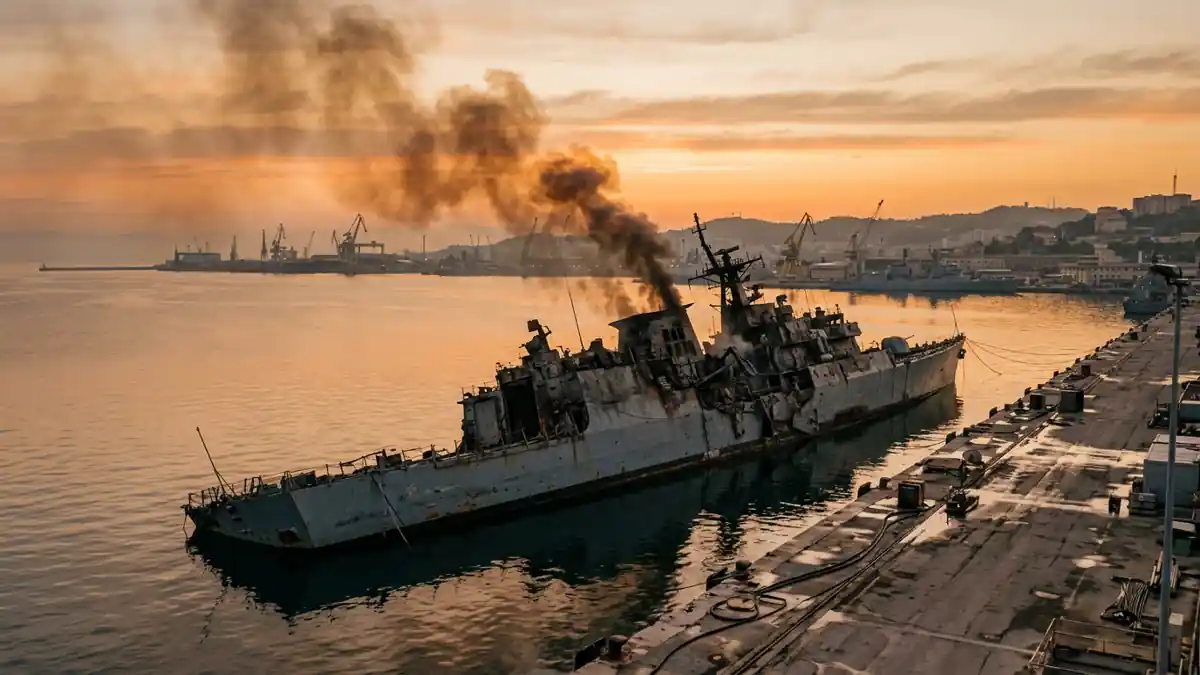
A Russian warship was sunk at a Libyan naval base on Sunday 22 November 2026, and Ukraine has now said it did it. President Volodymyr Zelenskyy confirmed on Monday that seven naval drones destroyed the corvette Merkury at Benghazi, taking the war far beyond Europe and raising fresh questions for Nato and for Britain.
Key points
- Ukraine says seven naval drones sank the Russian corvette Merkury at the Benghazi naval base in eastern Libya on 22 November 2026.
- Zelenskyy said a second vessel, the cargo ship MV Angara, was also hit, which he claimed Russia used to carry weapons.
- The UN mission in Libya expressed “serious concern” and called for an independent investigation.
- The attack followed a drone strike on the Russian cargo ship Sparta II in the Gulf of Finland on 21 November.
What happened to the Russian warship in Libya?
The Merkury, a Steregushchiy-class corvette, was hit at dawn on Sunday while docked at the Benghazi naval base to refuel and resupply on its way back to Russia, according to the eastern Libyan government. Satellite imagery from US firm Vantor, reported by the BBC, showed the ship capsized with only its bow visible.
Zelenskyy published footage taken from an approaching drone, which Reuters said it had verified. He said a Russian Ka-27 helicopter was also destroyed. Ukraine’s security service, the SBU, said the drones were launched from a “mother ship” and that Russian forces failed to stop them.
Libyan military officials gave a messier account, telling Reuters their forces had intercepted more than 20 maritime drones near Benghazi that evening. It was not immediately clear how that figure related to the seven Ukraine described.
Why does Libya matter in the Russia-Ukraine war?
Libya matters because eastern Libya, run by commander Khalifa Haftar, hosts Russian naval visits under a cooperation agreement, making Benghazi a staging post for Moscow’s presence in North Africa and the Sahel. Libya has been divided since the fall of Muammar Gaddafi in 2011.
The Institute for the Study of War said the Merkury had stopped over for several days to escort Russian cargo ships that can carry military supplies. Reuters reported that Zelenskyy’s post was the first official Ukrainian acknowledgement of an attack in Libya. In March, Russia accused Ukraine of striking the tanker Arctic Metagaz with drones launched from the Libyan coast; Kyiv has never claimed that attack.
The ship also carried symbolism. The Guardian noted that Vladimir Putin toured the yard where it was built in 2019 and singled it out at the 2023 Navy Day parade.
How has Russia and Libya responded?
Russia has said little. Kremlin spokesman Dmitry Peskov declined to comment on Libya, saying the Defence Ministry would provide information, but warned of “escalation of tensions in the region” and called the “expansion of terrorist activity in the Baltic” a “dangerous trend”.
Libya’s eastern government condemned an attack on a ship inside its port as a violation of its sovereignty, and its prime minister, Osama Hamad, asked the UN to investigate suspicions that the boats were launched from western Libya. The rival Tripoli government warned against involving civilian ports in external conflicts. The UN mission said Libya “must not become a battleground for foreign conflicts”.
What it means for the UK and what happens next
For UK readers, the strike shows the maritime front widening just as Europe tries to read Russia’s next move. A day earlier, the Sparta II, a Russian cargo ship run by defence logistics firm Oboronlogistika, caught fire in the Gulf of Finland after a drone attack that the Finnish military said was likely Ukrainian. Estonian and Finnish vessels helped tackle the blaze.
Dr Jalel Harchaoui of the Royal United Services Institute told the BBC that Haftar would take the attack as a personal slight and ask “who is hosting the Ukrainians”. Mykola Bielieskov of Kyiv’s National Institute for Strategic Studies called it “horizontal escalation”, as neither side can force terms on the battlefield alone.
Britain has been backing Ukraine’s drone effort; we reported on the UK’s supply of 1,000 drones to Kyiv only days ago, and on the Crimean bridge strike before that. US-backed talks between Moscow and Kyiv resumed this month after a nine-month pause, with little to show so far. Watch for a Russian response, any UN-led investigation in Libya, and whether more shipping becomes a target. More coverage is in our World section.