













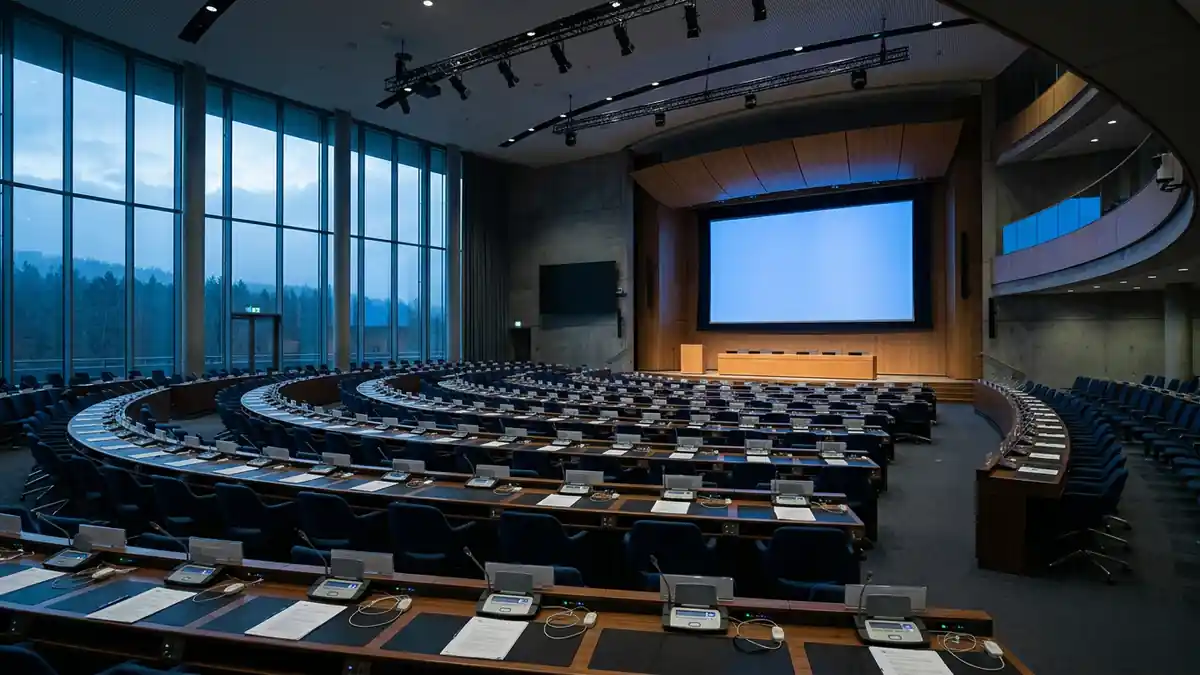
The COP31 climate talks in Antalya, Turkey, ended on 22 November 2026 without a consensus deal after the European Union and other delegations rejected a final draft that made no mention of fossil fuels. The summit is now the longest in COP history, and the UK’s energy secretary called the outcome “disappointing”.
Key points
- COP31 president Murat Kurum said on 22 November 2026 that the fourth draft had not been agreed and that there would be no new draft.
- The EU, Panama and the Marshall Islands were among those who rejected a text that contained no specific reference to transitioning away from fossil fuels.
- The draft acknowledged for the first time at a COP that the Paris Agreement goal of limiting warming to 1.5C will be missed.
- UK Energy Secretary Miatta Fahnbulleh called the lack of consensus “disappointing” and promised to keep working with partners.
Why did the COP31 climate talks fail?
The COP31 climate talks failed because the final draft, known as the Antalya Accords, left out any commitment to move away from fossil fuels, and the EU and others refused to accept that. Under UN rules every party must agree, so rejection by dozens of countries ended the deal.
A first draft earlier in the fortnight called for a faster phase-out of fossil fuels, according to the BBC. A pared-down version published on Thursday removed every mention of coal, oil and gas, prompting threats of a walkout. Producers led by Saudi Arabia had pushed for the removal.
Irish climate minister Darragh O’Brien, speaking for the EU, said it was “unconscionable that we would have a climate pact that makes no mention of fossil fuels”. He accused some oil states of hijacking the talks. Russia defended the omission, warning that a rapid exit from fossil fuels would lead to “fuel poverty”. China said it had concerns but would accept the text, the BBC’s live coverage reported.
What was in the final draft?
The final draft did not explicitly mention transitioning away from fossil fuels, but it did acknowledge a commitment countries made three years ago to do so. It also reduced references to carbon capture, use and storage, a technology France’s ecology minister Monique Barbut had criticised as a licence to keep burning oil and gas.
For the first time at a COP, the text recognised that the world is on track to miss the 1.5C limit set in Paris in 2015 and is entering a period of “overshoot”. Scientists warn that beyond that point millions more people will face sea level rise and extreme heat.
Money was the other fault line. Earlier versions included a pledge to raise adaptation finance to $120bn (£91bn) by 2035. That figure was removed and the decision pushed to future meetings. Ghana’s environment minister Zanetor Agyeman Rawlings, who chairs the African Group of negotiators, said: “We did not come here to beg.”
What did the UK say?
The UK government said it was disappointed but would keep pressing for progress. Energy Secretary Miatta Fahnbulleh, the UK’s chief negotiator, said the moment required “bold ambition” and that the result “only strengthens our resolve” to work with partners on overshoot.
UK delegation spokesperson Kate Hughes called the draft the “lowest common denominator” and said ambition fell short in three areas: adaptation finance, cutting emissions in line with 1.5C, and protecting forests, oceans and mountains.
What it means for the UK and what happens next
For UK households, nothing changes overnight: domestic targets and policies remain in force regardless of the Antalya outcome. The wider risk is slower global action on fossil fuels, which keeps energy markets exposed to the geopolitical shocks that have driven recent bills. Our World coverage follows the Gulf shipping attacks that have unsettled fuel prices.
The next step is unclear. The BBC’s Esme Stallard reported that the presidency could push the unresolved items to a halfway meeting in Bonn, as happened in 2000, or delay them to next year’s COP in Ethiopia. She warned that the acrimony could carry over.
UN Secretary-General António Guterres said he was “deeply disappointed” but that “there is no ambiguity in the science”. Former UN climate chief Christina Figueres, an architect of the Paris deal, said the absence of a cover decision should not be read as failure, since many technical decisions were adopted. Climate groups were harsher: Mohamed Adow of Power Shift Africa called COP31 the “worst ever COP”.
Background: how COP decisions are made
COP summits run on consensus among nearly 200 countries and have no mechanism to enforce promises, as the BBC’s climate editor Justin Rowlatt noted. COP31 ran past its Friday 20 November deadline by two days. If countries cannot agree, talks can be suspended until the following year, which has happened only once before. Readers following the UK’s wider politics can find more in our Politics section.